
Translated from the Korean original. Read the original
Why Check Sheave PCD Before Replacing Old Elevator Safety Parts
· 4 min read
- Sheave PCD
- Traction Machine
- Wire Rope
- Roping Ratio
- Safety Component Replacement
- On-site Measurement

Key points
- Sheave PCD is the criterion that determines the scope of replacement, helping define the review scope for the Traction Machine, Sheave, and surrounding components.
- PCD must be checked together with the existing rope specifications, including rope diameter, number of ropes, groove shape, and wear condition.
- Checking the Roping ratio and PCD together makes it easier to determine whether to replace only the Traction Machine or also review the ropes.
- Because the drawings and actual installation conditions may differ, it is advisable to retain both on-site measurements and photographic records.
- Accurately identifying the existing conditions at the outset can reduce unnecessary re-reviews, additional fabrication, and repeat site visits.
⚠ CautionThis article explains general inspection criteria. For maintenance decisions on a specific installation, please also check that model’s manual and inspection criteria.
In old elevator safety parts replacement work, schedules are often tight. On site, it is easy to check visible safety parts first, such as the Overspeed Governor, Safety Gear, and Buffer.
However, if the Traction Machine or sheave is also being reviewed on site, one of the items that should be checked first is sheave PCD. PCD is the reference dimension of the pitch circle on which the rope sits, and it directly affects judgment on the existing rope specification, roping ratio, machine room layout, and Traction Machine compatibility.
Sheave PCD Is a Standard That Divides the Replacement Scope
A sheave is not simply a rotating body through which the rope passes. It is a key part that determines the force transmission conditions between the rope and the Traction Machine.
Even elevators with the same Rated load can differ from site to site in the number of ropes, rope diameter, roping ratio, machine room space, and bed structure. When the sheave PCD changes, the rope travel path and tension conditions may also change together.
Therefore, if there is a possibility that Traction Machine replacement will be included in safety parts replacement work, the existing sheave PCD should be checked first. This makes it possible to judge early whether it is a simple sheave replacement, whether the Traction Machine and sheave need to be reviewed together, or whether surrounding parts will also be affected.
It Must Be Reviewed Together With the Existing Rope Specification
PCD checking cannot be separated from checking the rope specification. The rope diameter, number of ropes, groove shape, and wear condition must all match for a practical replacement judgment to be made on site.
If the plan is to continue using the existing rope, it is necessary to check whether the groove conditions of the new sheave match the existing rope. Conversely, if rope replacement is also planned, the rope selection and sheave conditions must be matched at the same time.
A problem that often occurs on site is a case where “the Traction Machine capacity appears to be correct, but the rope and sheave conditions do not match.” In this case, problems such as noise, uneven wear, slipping, and tension imbalance may occur after installation.
In old elevators, the existing drawings and the actual installation condition may also differ. Therefore, rather than judging only from the specifications on documents, it is advisable to keep site measurements and photo records together.
If the Roping Ratio Changes, the Judgment Also Changes
The roping ratio is related to the rope arrangement method that moves the car and Counterweight (CWT). If the roping ratio changes, the load conditions applied to the Traction Machine, rope speed, and sheave rotation conditions may change.
Therefore, when reviewing Traction Machine replacement, the existing roping ratio must be checked. It is difficult to judge that replacement is possible simply because it is “a Traction Machine of the same capacity.”
Especially at old sites, there may be cases where only some parts were replaced during renovation, making the conditions different from the original installation conditions. This is why the rope arrangement, sheave position, presence or absence of a Deflector sheave, and possible interference with the machine base are reviewed together.
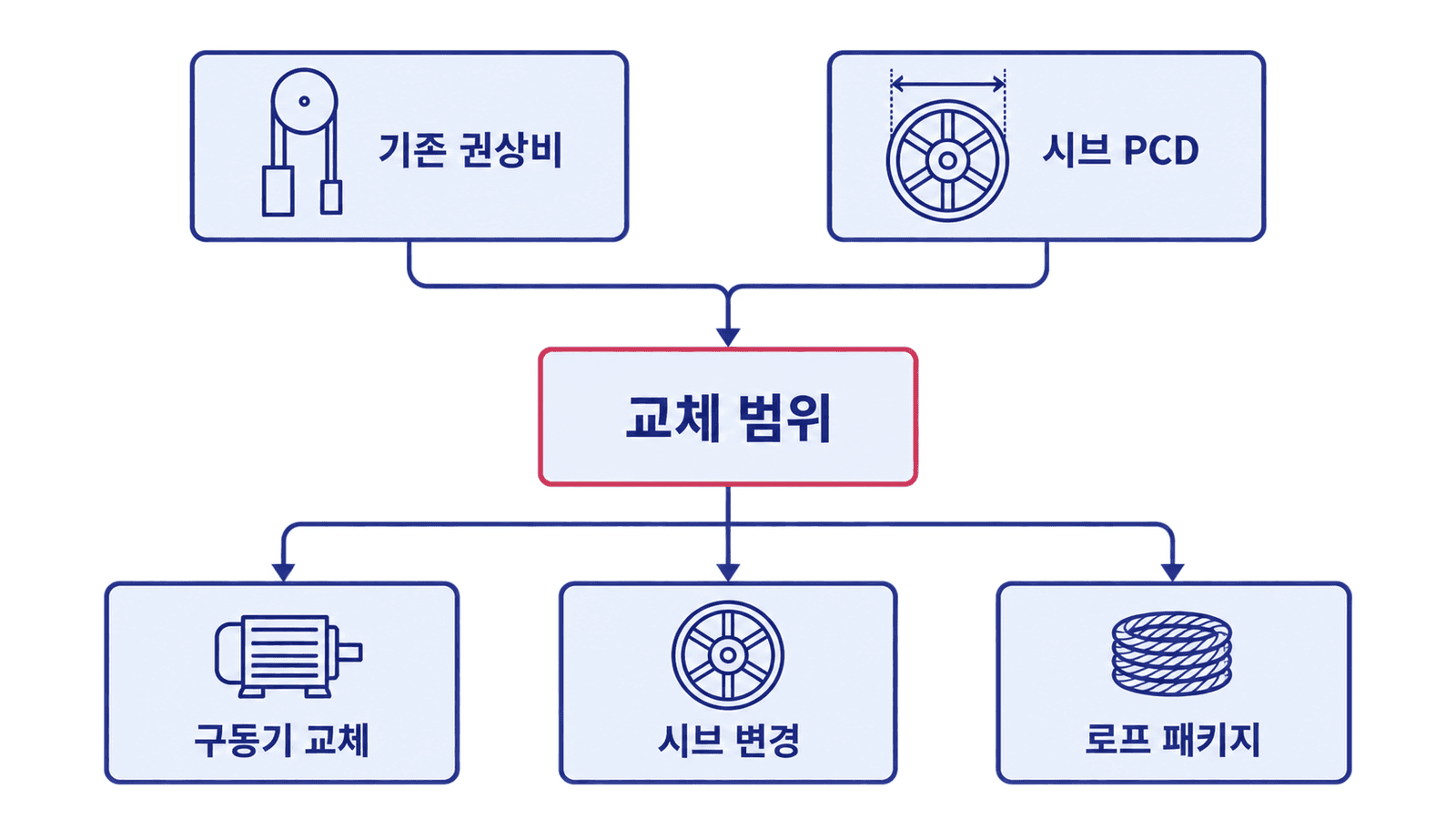
When the roping ratio and PCD are checked together, the scope of replacement work can be divided more clearly. It becomes easier to judge whether only the Traction Machine can be replaced, whether sheave fabrication or modification is required, or whether a package review including the rope is needed.
The Tighter the Schedule, the More Important Early Checking Becomes
Safety parts replacement work is often linked with regular inspection schedules, building operation schedules, and resident complaints. If a sheave PCD mismatch is found after site work has begun, delivery time and the work sequence can be significantly disrupted.
At the initial survey stage, it is advisable to check the following items together.
| Check item | Impact on site judgment |
|---|---|
| Existing rope diameter and number of ropes | Judgment on sheave groove suitability and whether the rope can be reused |
| Roping ratio | Traction Machine selection and review of rope speed conditions |
| Sheave PCD | Traction Machine and sheave compatibility, judgment on replacement scope |
| Sheave groove wear | Checking the possibility of rope uneven wear, noise, and slipping |
| Machine room layout | Checking delivery, bed fastening, and possible interference |
These items may appear separate, but in practice they are connected to one another. If one changes, the other conditions may also need to be checked again.
A PCD Lineup Improves Site Responsiveness
Old elevator sites have more variables than standardized new construction sites. Because there are many conditions that must be matched with the existing equipment, the range of sheave PCD choices is related to the flexibility of the replacement plan.
D&D handles Traction Machines and sheave-related parts, and can review various PCD conditions on site, including PCD 480, PCD 510, PCD 560, PCD 640, PCD 700, and PCD 710.
The important point is not a judgment that a particular PCD is always better. It is to functionally check whether it matches the existing rope, roping ratio, load conditions, and layout conditions.
On site, the existing conditions should first be identified accurately, and then the possible replacement scope should be narrowed down. This order must be followed to reduce unnecessary re-review, additional fabrication, and return visits.
Replacing safety parts in an old elevator is not a matter of changing one part, but of matching the conditions of the existing system and the new parts. Checking the sheave PCD first makes it possible to organize the relationship between the Traction Machine, rope, and sheave early.
Ultimately, a good replacement plan does not start with making big decisions quickly, but with first checking the standards that must not change. Checking the sheave PCD is a practical starting point for establishing that standard.
Frequently asked questions
- How should sheave PCD be checked on site?
- It is advisable to check the existing drawings first, while also inspecting the dimensions of the actually installed sheave and the rope arrangement. At old sites, the drawings and actual condition may differ because of past renovation history.
- If the rope is reused, is it enough to match only the sheave?
- In addition to the sheave PCD, the groove shape, rope diameter, wear condition, and tension balance must be reviewed together. Whether the rope can be reused requires a site condition judgment separate from the sheave conditions.
- Can only the sheave be replaced without replacing the Traction Machine?
- There are cases where this is possible, but the existing Traction Machine shaft, fastening structure, sheave conditions, roping ratio, and rope condition must match. Rather than deciding based only on simple dimensions, the overall drive conditions should be reviewed together.
- What changes if the PCD becomes larger or smaller?
- The reference radius around which the rope wraps and the rotation conditions may change. As a result, the rope path, tension conditions, and possible surrounding interference may need to be checked again.
Parts covered in this article
Products mentioned above, matched against our catalog.
Need to check whether it fits your site?
Tell us the model and site conditions — our team will confirm the specification and send a quote together with certificates and test reports.


