
Translated from the Korean original. Read the original
Bottom-type Overspeed Governors and MR&MRL Maintenance Access
· 14 min read
- Bottom-type Overspeed Governor
- MRL Overspeed Governor
- MR Overspeed Governor
- Governor Stand
- DND-GV-003
- DND-GV-002
- Elevator maintenance
- Inspection access route

Key points
- The bottom-type Overspeed Governor has inspection reference points closer to the lower part of the Hoistway, making it important to check Pit access, lighting, drainage, and workspace.
- The MR & MRL-type Overspeed Governor is linked to conditions in the machine room or upper part of the Hoistway, so the upper access route, mounting condition, and rope path should be checked first.
- Before inspection, first verify the model name and installation type, and distinguish whether even the same DND-GV-002 or DND-GV-003 is the MR & MRL type or the bottom type.
- Because Governor Stands have different fastening requirements, such as PCD240, MRL-type PCD240, and MRL-type PCD305, the on-site dimensions and mounting-surface condition must be checked together.
- Maintenance accessibility is not only a matter of component performance, but also of ensuring a location where workers can safely inspect, handle, and test the component.
⚠ CautionThis article explains general inspection criteria. For maintenance decisions on a specific installation, please also check that model’s manual and inspection criteria.
Contents▾
- 1.Why Accessibility Comes First in Selecting an Overspeed Governor
- 2.Inspection Routes That Change in MR&MRL Types
- 3.Inspection Routes That Change in Bottom Types
- 4.Model Name Confirmation Is the Starting Point of Inspection
- 5.Stand Conditions Form the Structure of Accessibility
- 6.Pre-check Sequence Before Inspection
- 7.Poor Accessibility Shakes Inspection Quality
- 8.Questions to Check at the Replacement and Selection Stage
- 9.Common Misunderstandings
- 10.Recording Makes the Next Inspection Easier
- 11.The Practical Conclusion Is Inspectability, Not Installation Position
Why Accessibility Comes First in Selecting an Overspeed Governor
An Overspeed Governor is a key component in the elevator safety device system that detects abnormal speed and, when necessary, leads to Safety Gear operation. When selecting one, operating characteristics, rope path, installation space, and surrounding structures should be reviewed together.
In maintenance sites, one more factor is added to this. That is accessibility. Depending on where the Overspeed Governor is placed, the inspector’s direction of movement, body position, tool posture, and the order of checks before and after testing all change.
Even within the same model series, the maintenance route is not the same when installed as an MR&MRL type and when installed as a bottom type. Therefore, rather than judging only by the part name, it is necessary to develop the habit of checking the installation type and stand conditions together.
The D&D product line includes Overspeed Governors and Governor Stands. DND-GV-003 and DND-GV-002 are provided as MR&MRL Overspeed Governors and bottom-type Overspeed Governors, respectively. On site, it must be confirmed whether this classification is consistent across the drawing, nameplate, order details, and actual installation position.
| Category | Item to check first | Meaning for maintenance |
|---|---|---|
| Model name | DND-GV-003, DND-GV-002, etc. | The starting point for part identification and data checking |
| Installation type | MR&MRL type, bottom type | Inspection position and movement route differ |
| Stand | PCD240, MRL type PCD240, MRL type PCD305 | Connected to checking the fastening surface, height, and surrounding interference |
| Rope path | Upper/lower direction, Tension Device position | Determines the sequence of testing and recovery work |
Inspection Routes That Change in MR&MRL Types
Sites Considered from the Upper Side
MR types are often reviewed together with machine room conditions, while MRL types are reviewed in connection with hoistway structures that do not have a separate machine room. Compared with bottom types, both types tend to have inspection reference points relatively closer to upper structures, machine beams, and the upper hoistway space.
At this point, the maintenance worker first checks the access route. They check whether machine room access is required, whether an upper hoistway work position is secured, whether visibility is available through the inspection opening, and whether tools can be inserted to check the fastening parts.
In MR&MRL types, the relationship with surrounding parts is important, not only the Overspeed Governor body itself. If there is interference with the Traction Machine, Sheave, rope, Guide rail, or upper frame, even a simple visual inspection may take longer. The higher the inspection position, the more work platforms, lighting, and fall prevention measures must be reviewed together.
Parts Easily Missed in MRL Types
MRL sites often have compressed space. Even if space is secured for the part to operate, there may not be enough space for a person to put in a hand and inspect it. Maintenance accessibility is the item that examines this difference.
For example, the nameplate may be visible but the adjustment point may not be within reach, or the fixing bolt may be visible but the posture needed to check torque may not be available. Under these conditions, the more inspection work is repeated, the more time it takes, and the greater the possibility of missing small abnormal signs.
When selecting or reviewing replacement of an MR&MRL type, do not look only at whether installation is possible; confirm whether the same location can be accessed repeatedly during regular inspections. The direction of the inspection opening, stand direction, nameplate direction, and rope entry and exit direction all affect maintenance accessibility.
Inspection Routes That Change in Bottom Types
Pit Accessibility Is Key
For a bottom-type Overspeed Governor, the inspector’s reference point becomes closer to the lower part of the hoistway. Therefore, pit entry conditions, floor condition, lighting, drainage, and interference from surrounding piping or cables must be checked first.
A device installed at the bottom may have the advantage of being viewed from relatively close range by the worker. However, the pit is not a consistent working environment. Moisture, dust, narrow space, low illumination, and interference with other lower devices affect inspection quality.
For bottom types, access to the body alone is not enough. The path where the rope descends and connects to the Tension Device, the tension condition, and whether the rope touches guides or surrounding structures must be checked together. Since an abnormality visible at the bottom may actually have started from a problem in the upper path, conclusions must not be made by looking only at the bottom.
Check Work Posture and Recovery Route
Bottom-type inspections often require a lower work posture. If the maintenance worker must bend their knees or twist their body to check the location, reading the nameplate and checking fastening parts can become more difficult than expected.
The recovery route after testing must also be checked. When Overspeed Governor operation confirmation, switch status confirmation, rope condition confirmation, and rechecking surrounding interference continue in sequence, it is important whether the worker can handle all of them from the same position or must move repeatedly between upper and lower areas.
Bottom types often fit sites well. However, it is more accurate to summarize that judgment as “it can be safely accessed and repeatedly inspected under pit conditions,” not “it is easy because it is below.”
| Item | MR&MRL type access | Bottom-type access |
|---|---|---|
| Main inspection position | Linked to machine room or upper hoistway conditions | Linked to pit and lower hoistway conditions |
| Pre-work check | Upper access route, inspection opening, fixing surface | Pit entry, lighting, floor condition |
| Interference check | Traction Machine, Sheave, upper frame | Tension Device, around Buffer, lower wiring |
| Repeat inspectability | Work posture at a high position is key | Work posture at a low position is key |
| Recovery route | Lower confirmation may be needed after upper confirmation | Upper path confirmation may be needed after lower confirmation |
Model Name Confirmation Is the Starting Point of Inspection
Distinguish Installation Type Even If Names Look the Same
Before elevator inspection, the first thing to check is the Overspeed Governor model name. The model name identifies the part and serves as the basis for connecting certificates, specifications, inspection records, and replacement history.
DND-GV-003 is provided as an MR&MRL Overspeed Governor and as a bottom-type Overspeed Governor. DND-GV-002 is also provided as an MR&MRL Overspeed Governor and as a bottom-type Overspeed Governor. Therefore, on site, do not stop at “this is DND-GV-003”; confirm “which installation type of DND-GV-003 it is.”
The model name and installation type must match across the nameplate, completion documents, maintenance data, and order details. If the documentation indicates an MR&MRL type but the actual site has it installed at the bottom, or if the stand condition is different, the inspector must record that difference.
Sites Where the Nameplate Is Hard to Read Need Separate Management
If the nameplate is not visible or is contaminated and difficult to read, the starting point for maintenance judgment becomes unstable. Bottom types are especially prone to nameplate contamination depending on pit conditions, and MRL types may have the nameplate located behind a structure depending on installation direction.
In such cases, do not make forced assumptions; compare existing inspection records with drawings. If the installation position, rope path, stand shape, and fastening part position confirmed on site are recorded, the next inspector can avoid repeating the same problem.
| Check location | What to check | Example wording to record |
|---|---|---|
| Nameplate | Model name, manufacturer, identification information | Whether the model name can be read |
| Drawing | Installation type, rope path | Whether the drawing type and site match |
| Stand | PCD and whether it is MRL type | Whether fastening parts are accessible |
| Inspection record | Previous abnormalities, replacement history | Whether there are repeated remarks |
| Site photo | Nameplate direction, surrounding interference | Reference location for next inspection |
Stand Conditions Form the Structure of Accessibility
Check PCD and Fixing Surface Together
The Governor Stand should not be regarded simply as a part that supports the body. The stand affects the body’s position, height, direction, fastening accessibility, and rope alignment.
D&D Governor Stands include PCD240, MRL type PCD240, and MRL type PCD305. Here, PCD is used as a basis for checking fastening conditions. On site, the stand’s PCD marking, the actual fixing surface, and whether the fastening parts can be accessed must be checked together.
If the stand does not fit, maintainability may decline even if the body is fixed. Situations may occur where the bolt fastening direction is blocked by a structure, there is not enough room to insert tools, or the rope center appears misaligned. These problems are felt more strongly during regular inspection than immediately after installation.
MRL Type Stands Require More Detailed Space Interference Checks
MRL type stands are often used under conditions close to the internal structure of the hoistway. Therefore, it is necessary to examine whether the height and direction in which the body is installed match the surrounding devices.
The inspector does not only check whether the stand is firmly fixed. They also check whether fastening parts can be accessed, whether there are signs of vibration during long-term operation, whether the rope passes through a natural path, and whether the inspector can secure visibility.
Stand selection is not only a matter of installation possibility but also a matter of maintainability. In replacement sites in particular, the hole positions, reinforcements, interference objects, and existing rope path of the existing structure remain, so a procedure is needed to confirm whether the new stand matches the site conditions.
| Stand category | Check point | Effect on maintenance accessibility |
|---|---|---|
| PCD240 | Fastening part position and fixing surface condition | Connected to general fastening access and body direction confirmation |
| MRL type PCD240 | Internal hoistway interference and inspection opening direction | Tool accessibility is important in narrow spaces |
| MRL type PCD305 | Fastening interval and structural clearance | Surrounding frame and rope path must be checked together |
Pre-check Sequence Before Inspection
Move from Documents to the Site
Inspection appears to begin on site, but in practice it is more stable to begin with document checking. First, confirm the Overspeed Governor model name and installation type in maintenance records, drawings, and the parts list.
Then enter the site and compare the nameplate with the actual installation position. If the data and the site match, it is easy to set the inspection sequence. If the data and the site differ, that difference must be recorded first, and additional confirmation should be carried out if necessary.
Because the Overspeed Governor is connected to the safety device system, the inspector does not look at one part in isolation. The Overspeed Governor body, rope, Tension Device, switch, safety circuit response, and linkage with the Safety Gear are checked in sequence. If accessibility is poor, this sequence is easily broken.
Draw the Movement Route First on Site
Once on site, it is better to first map where the inspector will look from and where they will move, rather than touching the part immediately. For MR&MRL types, the upper access route and lower confirmation route are viewed separately; for bottom types, the pit access route and upper path confirmation route are viewed together.
Before inspection, the following items can be organized.
| Sequence | Check item | Judgment criterion |
|---|---|---|
| 1 | Model name | Check whether DND-GV-002, DND-GV-003, etc. can be identified |
| 2 | Installation type | Confirm from the site position whether it is MR&MRL type or bottom type |
| 3 | Stand | Compare PCD240, MRL type PCD240, and MRL type PCD305 conditions |
| 4 | Access route | Confirm machine room, inspection opening, and pit entry conditions |
| 5 | Rope path | Check interference, bending, and Tension Device condition |
| 6 | Record | Leave differences between data and site |
Following this sequence reduces the possibility that the inspector will have to make rushed judgments after arriving on site. Especially in buildings where multiple units are inspected at once, simply classifying models and types first helps organize the work sequence.
Poor Accessibility Shakes Inspection Quality
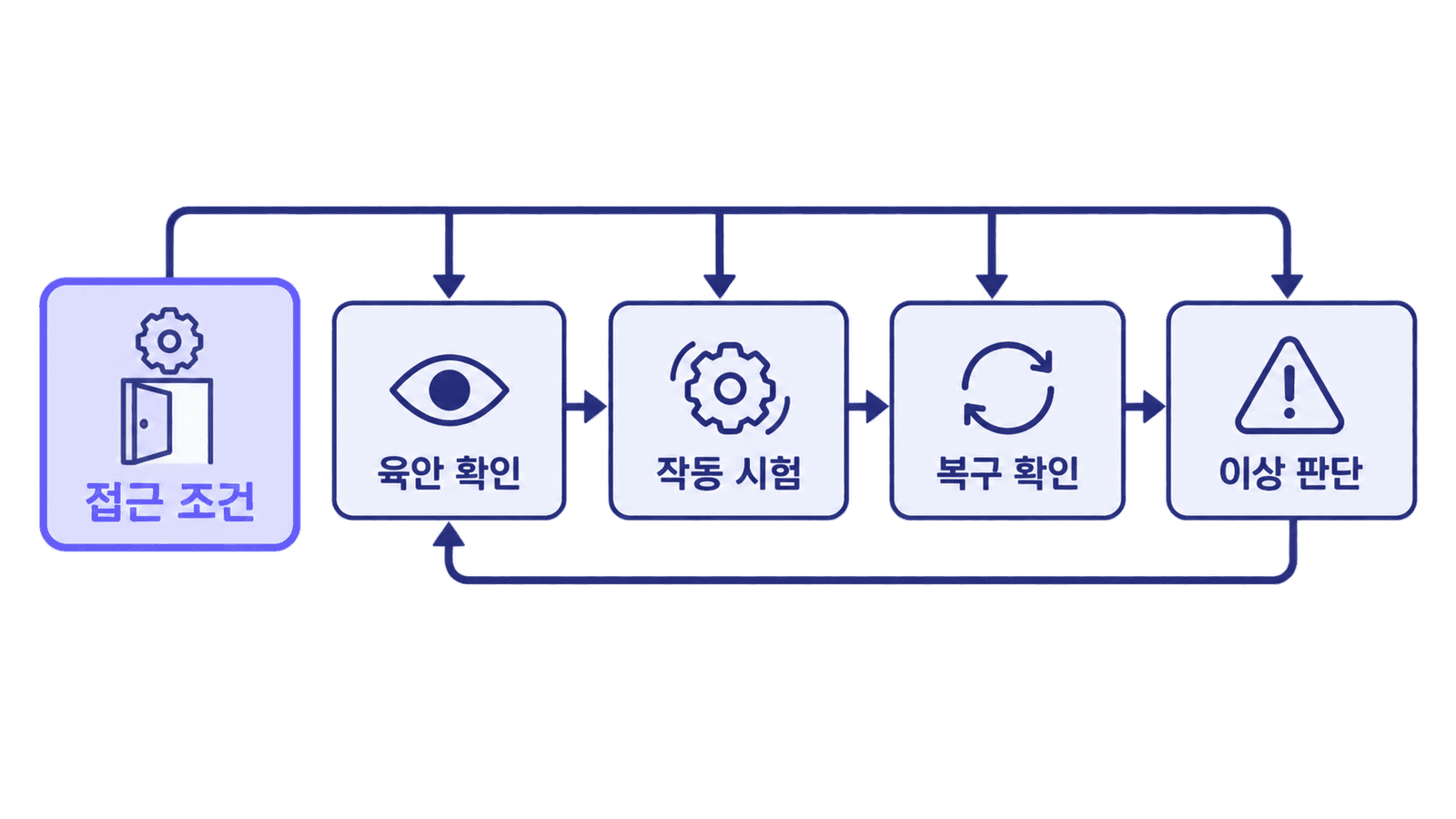
Judgment Is Delayed for Areas That Cannot Be Seen
Even if the Overspeed Governor itself is normal, maintenance quality can decline if it is in a position the inspector cannot check. Maintenance is repeated work. The same areas must be viewed each time, compared by the same criteria, and changes must be recorded if present.
At sites with poor accessibility, comparing changes is difficult. A fastening part that was visible last time may not be clearly visible this time due to insufficient lighting, or the worker may be unable to position their body and properly check rope contact marks. In such cases, abnormal signs are discovered late not because of a part problem, but because of observation conditions.
Maintenance accessibility does not only mean worker convenience. It means conditions under which the state of the safety device can be checked consistently. That is why it is important to reflect accessibility at the new installation or replacement review stage.
Testing and Recovery Must Continue as One Flow
Overspeed Governor inspection does not end with visual confirmation. Depending on site conditions and inspection scope, operation confirmation, switch confirmation, rope condition confirmation, and recovery confirmation follow. This process must continue as one flow to reduce work errors.
In MR&MRL types, there may be cases where what was confirmed at the upper side must be matched against the lower Tension Device. In bottom types, there may be cases where what was confirmed in the pit must be matched against the upper rope path. In either case, rather than completing all judgment from one position, a perspective that views the entire connected system is needed.
A site with good accessibility is a site where the inspector can find abnormalities quickly. More precisely, it is a site where observation conditions for distinguishing normal from abnormal are well prepared.
Questions to Check at the Replacement and Selection Stage
Translate Building Conditions into Part Conditions
Whether a bottom type or MR&MRL type is suitable cannot be decided simply by preference. Building structure, existing rope path, presence or absence of a machine room, pit condition, inspection opening position, and maintenance method all act together.
The maintenance worker must turn building conditions into part conditions and ask questions. It is a way of asking “can regular inspection be repeated after installation?” rather than “can it be installed?”
For example, if the pit is narrow or habitually wet, bottom-type accessibility may be limited. Conversely, if the upper inspection opening is narrow and MRL devices are densely arranged, MR&MRL type inspectability may be low. No single type gives the same answer for every site.
Check Questions Should Be Short and Specific
Before replacement or new selection, it is good to check the following questions on site.
| Question | Reason for checking |
|---|---|
| Is the model name the same on site and in the documents? | Reduces misjudgment caused by data mismatch |
| What is the actual installation type, MR&MRL type or bottom type? | Inspection route and required safety measures differ |
| Does the stand PCD condition match? | Affects fastening stability and tool accessibility |
| Can the nameplate and adjustment points be seen? | Basic condition for repeated inspection and record management |
| Is there no interference in the rope path? | Connected to operating reliability and recovery confirmation |
| Is the pit or upper work environment stable? | Determines inspector safety and work quality |
D&D has a history of obtaining parts safety certification for Overspeed Governors in 2020. However, in site maintenance, accessibility is not guaranteed by certification history alone. Separately from certification, site installation conditions, stand conditions, and inspection routes must be checked directly.
Common Misunderstandings
Misunderstanding That Bottom Types Are Always Easy to Inspect
Bottom types may have the advantage that the worker can check them at a position close to ground level. However, if pit conditions are poor, accessibility can instead decline. Low position, moisture, insufficient lighting, and interference from surrounding devices all affect inspection quality.
Therefore, a bottom type should be judged not as “it is easy because it is below,” but as “are the pit conditions suitable for inspection?” Especially in existing buildings, the internal layout of the pit is already fixed, so the space for the new part and the space for a person to work must be examined separately.
Misunderstanding That MR&MRL Types Are Inconvenient Because They Are Above
MR&MRL types can also have stable maintenance routes if site conditions are suitable. If machine room access is good, the inspection opening is appropriate, and the stand and body direction fit well, repeated inspection is not difficult.
The issue is not the fact that it is above, but whether the inspector can check the necessary items at that position. If the nameplate, fastening parts, rope path, switch status, and surrounding interference can be checked, maintainability is secured even for MR&MRL types.
Misunderstanding That the Stand Is an Accessory
The stand is a structural element that determines maintenance accessibility for the Overspeed Governor. Even if the body is in the same series, changes in stand conditions can change the inspection direction and tool accessibility.
MRL type stands in particular are often reviewed together with space constraints, so the stand name and PCD conditions must not be passed over lightly. It is necessary to check together whether the fastening conditions match, whether the fixing surface is sufficient, and whether there is interference with surrounding structures.
Recording Makes the Next Inspection Easier
Accessibility information confirmed by the inspector on site reduces time for the next inspector. It is good to record at least briefly the model name, installation type, stand conditions, nameplate position, access restrictions, and special points in the rope path.
Classification is especially important in buildings where bottom types and MR&MRL types are mixed. Even within the same building, installation conditions may differ by unit. Without records, everything must be checked again on site each time, and the work sequence is also disrupted.
Photo records also help. However, photos must be left together with readable information. They can be used as data later only when taken with a purpose, such as photos showing the nameplate, photos showing the stand fastening parts, and photos showing the rope path.
It is good to distinguish judgment from fact in records. If only “difficult access” is written, it is hard for the next person to know the cause. If the location and cause are left, such as “fastening part access restricted due to pipe interference on the left side of the pit,” action review becomes easier.
| Record item | Good recording direction |
|---|---|
| Model name | Leave both the nameplate-based model name and whether it can be read |
| Installation type | Write MR&MRL type or bottom type based on the actual position |
| Stand | Record PCD condition and fastening accessibility together |
| Restrictions | Specify causes such as lighting, space, moisture, and interference objects |
| Follow-up action | Leave whether rechecking, cleaning, data comparison, or part review is needed |
The Practical Conclusion Is Inspectability, Not Installation Position
The difference between bottom-type Overspeed Governors and MR&MRL type Overspeed Governors is not simply whether they are above or below. It is a matter of what route the maintenance worker uses to access them, what posture is used to check them, and in what sequence recovery is confirmed after testing.
Before elevator inspection, the model name must be checked first. Since MR&MRL type and bottom type may be distinguished even within the same model series, such as DND-GV-002 and DND-GV-003, the installation type must be checked together.
Next is the stand. Conditions such as PCD240, MRL type PCD240, and MRL type PCD305 affect not only fastening and arrangement but also maintenance accessibility. Do not regard the stand only as an accessory; it should be viewed as a structural condition that forms the inspection route.
The best judgment on site is simple. A good configuration is one in which the maintenance worker can access safely, repeatedly check the necessary areas, and records match the actual installation state. Selecting an Overspeed Governor is both a part selection and a selection of the maintenance route.
Frequently asked questions
- How does maintenance accessibility differ between bottom-type Overspeed Governors and MR&MRL types?
- For bottom types, pit and lower hoistway conditions are important, while for MR&MRL types, machine room or upper hoistway access conditions are important. Therefore, lighting, work posture, inspection openings, stand direction, and rope path must be checked differently by installation type.
- Before elevator inspection, what should be checked first for the Overspeed Governor model name and stand conditions?
- First, check the model name on the nameplate and in inspection records, and distinguish whether DND-GV-002 or DND-GV-003 is MR&MRL type or bottom type. Then check whether the stand condition is PCD240, MRL type PCD240, or MRL type PCD305.
- Can a bottom type be considered easier to inspect?
- It is difficult to conclude that. A bottom type may have the advantage of being checked from close range, but inspectability may decline if the pit is narrow, dark, or wet.
- What should be checked especially in an MRL type Overspeed Governor?
- The inspection opening direction, stand fixing condition, interference with surrounding structures, whether the nameplate can be read, and rope path should be checked together. At sites with compressed space, tool accessibility is also an important check item.
- Why does a maintenance worker need to know the stand PCD condition?
- PCD conditions are connected to checking the fastening position and fixing surface. If the stand does not match the site structure, the body may be installed but checking the fastening parts or accessing them with tools may become difficult.
- What should be done if the documents and actual installation type differ?
- Do not make assumptions on site; compare the nameplate, drawings, and previous inspection records. If a difference is confirmed, it is good to record the installation position, whether the model name can be read, stand conditions, and rope path so that follow-up confirmation is possible.
Parts covered in this article
Products mentioned above, matched against our catalog.
Need to check whether it fits your site?
Tell us the model and site conditions — our team will confirm the specification and send a quote together with certificates and test reports.


