
Translated from the Korean original. Read the original
UCMP Electronic Interlock Inspection and Car Door Opening Conditions
· 5 min read
- UCMP
- Electronic Interlock
- Car door
- Door-lock signal
- Safety circuit
- Maintenance

Key points
- The key to addressing UCMP is preventing car movement when the door is open or incompletely locked.
- The Electronic Interlock is a safety component that verifies whether car door closed, locked, and opening-permission signals are accurately transmitted to the control system.
- The car door must open only when the car is within the permitted range of the stopping floor and is stationary, and a normal opening command is issued.
- Electronic Interlock inspection sequentially checks the standalone component condition, signal transition timing, and whether operation is prevented during normal operation.
- After maintenance, verify that bypass wiring has been removed and signals have been restored; when replacing the component, review compatibility and safety-circuit input conditions.
⚠ CautionThis article explains general inspection criteria. For maintenance decisions on a specific installation, please also check that model’s manual and inspection criteria.
UCMP addresses the risk of unintended car movement when a door is open or not fully locked. In this context, an Electronic Interlock should be regarded not merely as a component that locks the door, but as a safety component that verifies whether the car door opening conditions and door-lock signals are correctly transmitted to the control system.
The Role of the Interlock in UCMP
UCMP protection cannot be achieved by a single component alone. The control panel, brake, Traction Machine, door circuit, detection devices and safety circuit must work together.
Among these components, the Electronic Interlock acts as the starting point for signals used to determine whether the door is closed, whether the locked state has been established and whether the car is in a position where opening is permitted.
What matters on site is not that “the door appears to be closed.” The inspector must verify that the following conditions match in both the actual circuit and the indication.
| Item to Verify | Purpose of Inspection |
|---|---|
| Car door closed state | Verify that the door panel is mechanically in the closed position. |
| Lock signal | Check whether the interlock contact or electronic detection signal switches to its normal state. |
| Opening permission conditions | Verify that the car door can open only under permitted conditions, such as when the car is near a landing. |
| Response to abnormal conditions | Check whether operation is prevented in the event of a signal mismatch, a partially closed door or defective locking. |
After replacing or adjusting an Electronic Interlock, it is not sufficient to check only whether the door operates smoothly. It is also necessary to verify how the safety circuit recognises the lock signal.
Car Door Opening Conditions Must Consider Both Position and State
The car door is not a device that opens solely for passenger convenience. It should open only when the elevator is within the permitted range of a landing, the car is stationary and the door-opening command is issued under normal conditions.
A UCMP inspection should therefore begin with the following questions.
First, is opening permitted only when the car is near a landing?
The door must open at a position where passengers can enter and exit. If the stopping position is uncertain or the levelling condition is unstable, the opening permission signal must also be inspected.
Second, is the door-lock signal being confused with permission to operate?
On site, the closed signal and lock signal can easily be treated as having the same meaning. However, they must be distinguished during a safety inspection. Even if the door appears closed, permission to operate must not be issued unless locking has been confirmed.
Third, do the conditions change during manual opening or maintenance mode?
Inspection operation, door adjustment and emergency release work can create conditions that differ from normal operation. In such cases, it is necessary to verify that the interlock signal has not been left with temporary wiring or in a bypassed state.
It Is Safer to Verify Door-Lock Signals in Sequence
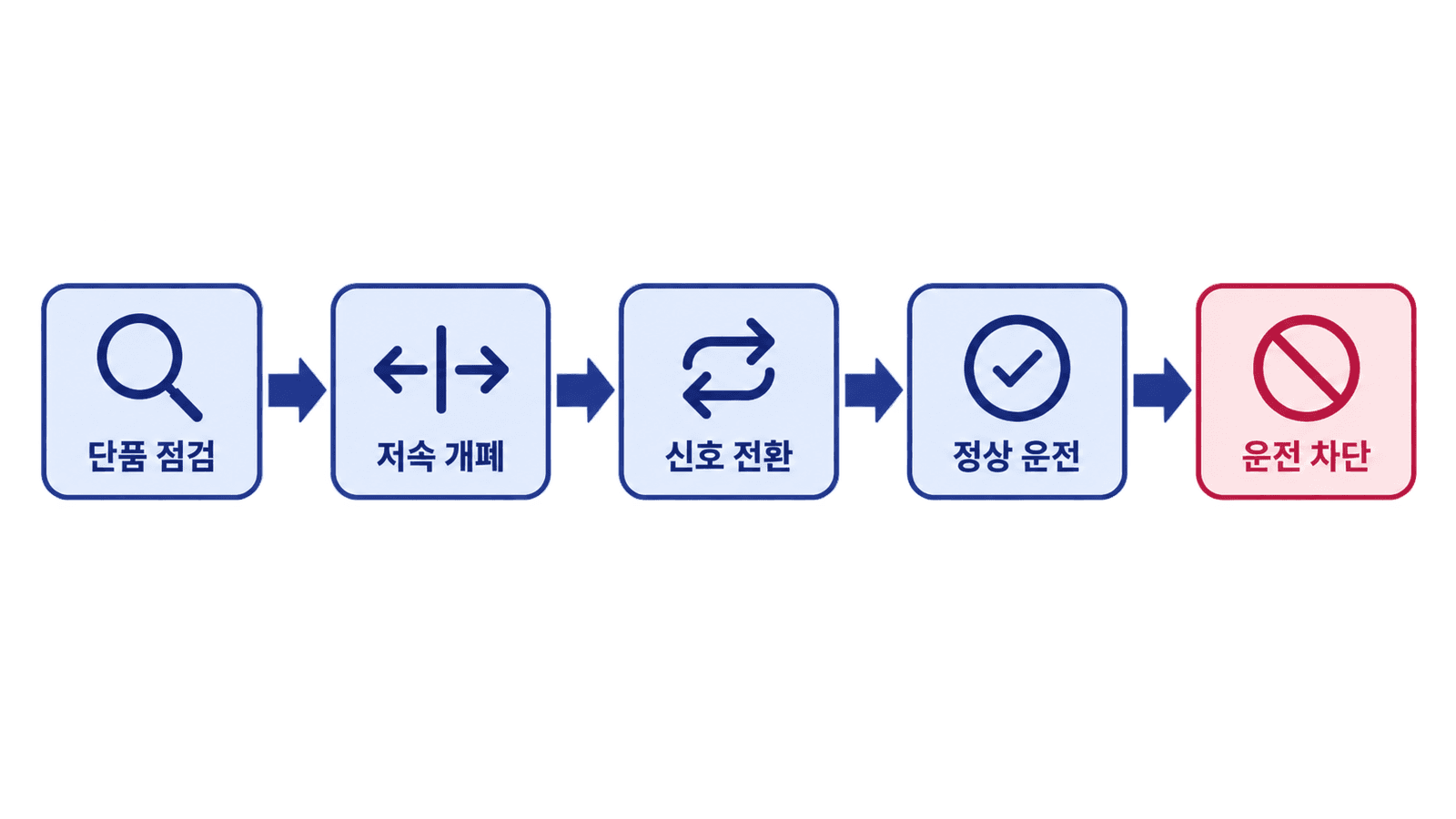
It is advisable to inspect an Electronic Interlock by separating the individual component operation check from the system check.
First, inspect the fastening points, wiring, connectors, contamination of the detection unit, foreign matter and loosened fixing bolts at the individual component level. At sites with significant door vibration, the position may shift slightly after repeated operation.
Next, slowly open and close the car door while checking the signal switching point. Verify that the signal is received reliably only at the fully closed position and that the lock signal is not established prematurely while the door is not fully closed.
Finally, conduct checks under normal operating conditions. Check whether call operation, automatic operation and restarting are prevented when the door is open or locking has not been established. If an abnormality is found at this stage, the entire door circuit and control inputs must be traced, not just the interlock.
No Temporary Measures Should Remain After Maintenance
During on-site maintenance, a circuit may be temporarily disconnected or a specific input may be forced for troubleshooting purposes. The problem arises when traces of these measures remain after the work is completed.
After inspecting an Electronic Interlock for UCMP protection, it is necessary to make a separate check of the following items.
- Verify that no temporary jumper wires, bypass wiring or test terminals remain.
- Verify that the door closed and lock signals are each indicated normally.
- Verify that permission to operate is prevented when the car door is slightly open.
- Verify that the signal state returns to normal after a power failure, reset or return from inspection operation.
- Record the inspection results by component name, action taken and inspector.
In particular, an Electronic Interlock requires a different inspection approach from one that examines only mechanical contacts. The input power, sensor unit, logic output and reflection of the signal in the safety circuit must all be checked together.
Replacement Decisions Should Be Based on Repeatability, Not Merely the Presence of a Fault
Interlock-related abnormalities may not occur every time. They may arise only when the door closes at a specific speed, or the signal may fluctuate momentarily depending on temperature, vibration or contamination.
It is therefore difficult to conclude an inspection merely because the device “operated normally once.” Checks must be performed separately during repeated opening and closing, under changing passenger loads, and after switching between inspection operation and normal operation.
When replacing an Electronic Interlock, the wiring method of the existing component and the safety-circuit input conditions must not be changed arbitrarily. Compatibility, certification scope, installation orientation, operating clearance and the condition of wiring protection must be verified before installation.
For the Electronic Interlocks supplied by D&D Co., Ltd., it is likewise important in this context not only to supply the individual component but also to verify the conditions for its on-site application. Normal operation of the component itself and its correct recognition by the elevator’s overall safety circuit are separate items to be verified.
The core principle of UCMP inspection is clearer than its complex terminology might suggest. The car must not move while a door is open or incompletely locked, and opening must be permitted only under conditions in which the door is allowed to open. An Electronic Interlock inspection is the procedure for verifying this principle on site through signals, position and operating sequence.
Frequently asked questions
- Can an interlock inspection be considered complete once the car door closes?
- No. The closed state and the lock signal must be verified separately. Even if the door appears closed, permission to operate must not be issued unless the lock signal has been properly established.
- What should be checked first after replacing an Electronic Interlock?
- After checking the wiring and fastening condition, verify that the signal switching point is correct during the car door opening and closing process. Then confirm during normal operation that operation is prevented if the door-lock condition has not been established.
- Why are maintenance records important in a UCMP inspection?
- Interlock abnormalities can occur intermittently. Recording the adjustment position, replacement component and signal verification results helps trace the cause if the problem recurs and supports subsequent periodic inspections.
- Is it acceptable to use a temporary jumper wire if it is used only during the work?
- Even if it was used to identify the cause during the work, it must be confirmed as removed after the system is restored. If the bypassed state remains, the door-lock safety circuit may lose its purpose.
Parts covered in this article
Products mentioned above, matched against our catalog.
Certificates & technical documents
Sources
- [1]국가법령정보센터 - 승강기 안전관리법law.go.kr
- [2]국가법령정보센터 - 승강기 안전부품 안전기준 및 승강기 안전기준law.go.kr
- [3]한국승강기안전공단koelsa.or.kr
- [4]ISO 8100-1:2026 — 승강기 안전기준iso.org
Need to check whether it fits your site?
Tell us the model and site conditions — our team will confirm the specification and send a quote together with certificates and test reports.


