
Translated from the Korean original. Read the original
Diagnosing Wire Rope Wear Patterns on Double Wrap Sheaves
· 5 min read
- Double Wrap sheave
- Wire rope
- Rope tension
- Sheave alignment
- Wear diagnosis
- Noise and vibration

Key points
- Double Wrap wear is often the cumulative result of repeated contact conditions rather than the result of a single component.
- Rope damage must be assessed by examining sheave grooves, tension, noise, and vibration as a single pattern.
- Continuous wear on one side requires checking fleet angle, sheave alignment, and groove sidewall contact first.
- For sheave grooves, inspect not only the bottom but also differences in gloss between both walls, ridges, peeling, and foreign matter.
- Before and after adjustment, repeat the measurements at the same locations and under the same operating conditions to compare any changes.
⚠ CautionThis article explains general inspection criteria. For maintenance decisions on a specific installation, please also check that model’s manual and inspection criteria.
A Double Wrap Traction Machine brings the ropes into contact with the sheave system multiple times. This is advantageous for securing sufficient traction, but small differences in groove condition, alignment, and rope tension can become visible as wear through repeated contact.
In the field, the cause can be identified more accurately by interpreting the ropes, sheave grooves, tension, noise, and vibration as a single pattern rather than examining rope damage in isolation.
In Double Wrap systems, repeated contact must be considered together
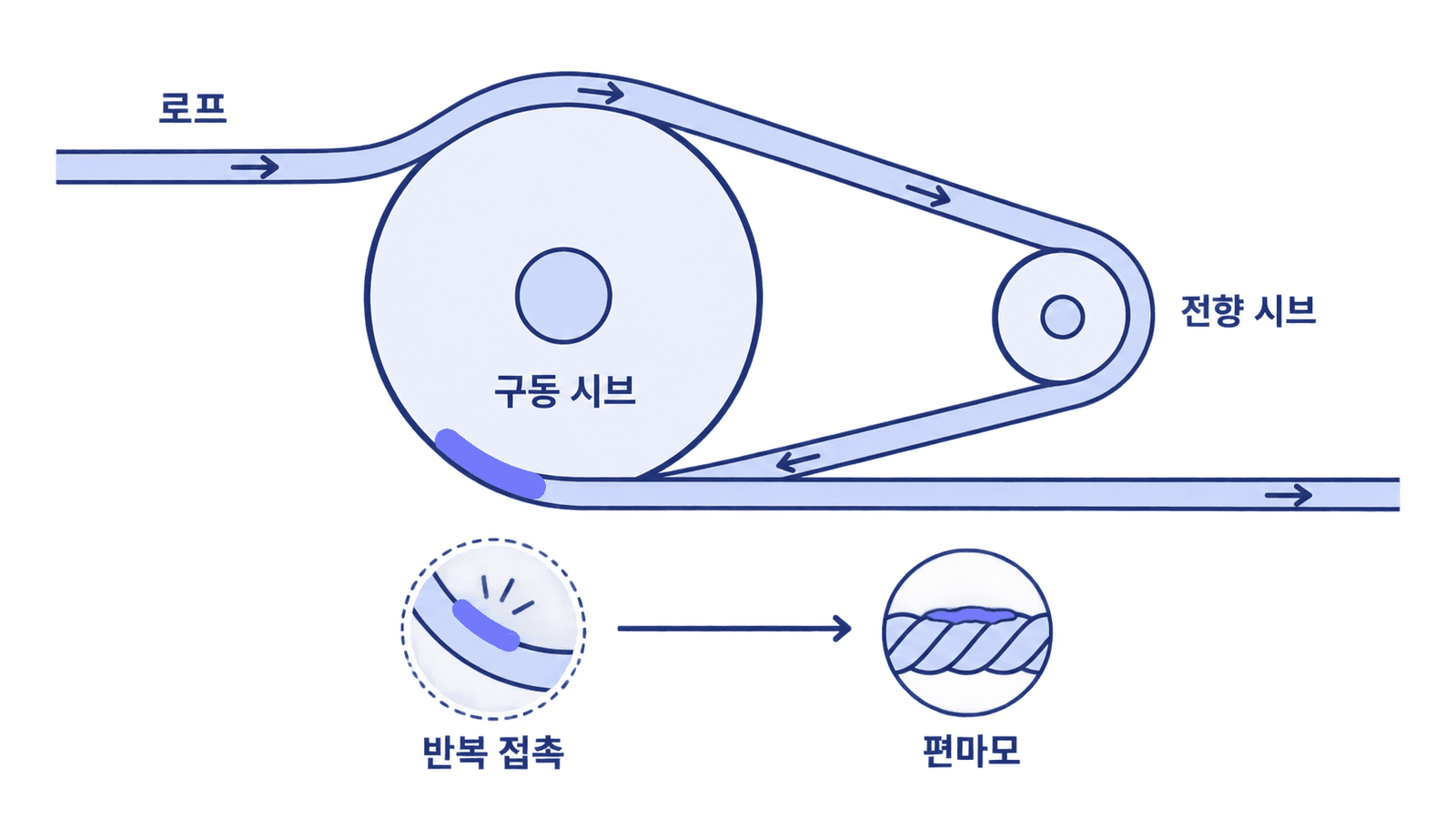
When a rope wraps around a sheave and then makes contact again, bending and contact pressure are repeated. Even on the same rope, the bending direction and groove entry conditions may differ at each contact point.
If the shafts of the sheave and deflector sheave are misaligned, the rope cannot enter the centre of the groove. Contact then becomes concentrated on one sidewall of the groove, and the outer wires of the rope may also wear more quickly in a particular direction.
If rope tension is uneven, the rope with higher tension bears more of the load. Polishing, metal dust, and changes in groove depth may appear relatively earlier on that rope and its groove.
Conversely, a rope with lower tension may produce slight slipping or vibration under certain operating conditions. Therefore, replacing only the rope with the greatest wear may leave the underlying cause unresolved.
Narrow down the possible causes using marks on the rope surface
If the outer circumference of the rope is worn relatively evenly, first check for long-term normal contact and the lubrication condition. However, compare whether all ropes in the same section show a similar degree of wear.
If flat wear continues along only one side, the fleet angle, sheave alignment, and contact with the groove sidewall may be suspected. It is also advisable to record whether the direction of wear repeats along the travel section.
If only some ropes are unusually brightly polished or have large amounts of metal dust, check both tension differences and variations in groove geometry. Localised reddish-brown dust may be a sign of friction caused by micro-movement, but corrosion or wear should not be concluded from colour alone.
If broken wires, crushing, diameter reduction, or abnormal twisting are visible, they must be evaluated immediately according to the operating conditions and manufacturer’s criteria. Do not arbitrarily smooth the damaged area or conceal it with lubricant.
| Observed pattern | Items to check first |
|---|---|
| Rapid wear on only a particular rope | Tension of each rope, groove depth, rope seating condition |
| Continuous wear on one side of a rope | Sheave alignment, fleet angle, contact with the groove sidewall |
| Similar polishing on all ropes | Service history, lubrication condition, contact pressure and operating frequency |
| Metal dust accompanied by noise | Slipping, groove surface, tension differences, foreign matter |
| Repeated damage at a fixed position | Rope connection, sheave eccentricity, local deformation, travel section |
Inspect sheave grooves together with the ropes
When inspecting sheave grooves, looking only at the bottom of the groove is insufficient. Also examine differences in polishing between the two sidewalls, ridges at the edges, surface flaking, and attached foreign matter.
If the rope seats at a different depth in each groove, load distribution may vary. Use an appropriate gauge and the manufacturer’s criteria to determine whether the rope in one groove sits excessively deep or makes abnormal contact with the groove bottom.
Uneven wear on the groove surface may result from rope tension imbalance or, conversely, may cause the tension difference to increase. The groove condition must therefore be compared at the same locations and under the same conditions before and after rope adjustment.
When the Traction Machine type differs, such as Slim Type, Pencil Type, or Double Wrap, the rope path and inspection access points also differ. When reviewing the MCK Traction Machine line or a Double Wrap Traction Machine, do not select parts based on the name alone. Compare the existing rope path and sheave configuration with the certification and technical documents.
Field compatibility of Double Wrap products classified by a particular pitch-circle diameter also cannot be determined from the diameter alone. The rope specifications, groove geometry, load conditions, installation dimensions, and applicable documents must all be checked.
Record when noise and vibration occur
Rope and sheave problems may first appear under particular operating conditions rather than as a constant sound. Record the differences during starting, deceleration, immediately before stopping at a floor, and transitions between upward and downward travel.
Compare periodic humming or pulsating vibration with the sheave rotation cycle and rope passage cycle. If it recurs only at a particular position, examine the sheave for eccentricity, the groove for local damage, or a particular section of the rope for deformation.
Adding lubricant first when squeaking or friction noise increases may obscure the cause. Confirm that the lubrication method is permitted by the wire rope manufacturer and the Traction Machine manufacturer, and ensure that it does not affect braking surfaces or traction conditions.
Noise assessment should not end with the sound level heard in the machine room or Hoistway. Separately inspect vibration inside the car, the Traction Machine supports, anti-vibration components, bearings, and brake condition.
Comparable field records are essential
Before inspection, keep the car position, direction of travel, load conditions, and observation points consistent. Then identify the position of each rope and record photographs and measurements in the same sequence.
The recommended inspection sequence is as follows.
- Mark the appearance and damage locations of each rope.
- Compare polishing, ridges, dust, and seating condition for each sheave groove.
- Check rope tension differences using an approved procedure.
- Inspect the alignment, rope path, and condition of rotating components.
- During a low-speed test run, record the conditions under which noise and vibration occur.
- After adjustment, repeat the measurements under the same conditions to determine whether anything has changed.
Adjusting rope tension or replacing a sheave can directly affect safety. Check the manufacturer’s manual, certification scope, and elevator inspection criteria, and ensure that the work is performed by qualified personnel.
Wear at Double Wrap installations is often the accumulated result of contact conditions rather than a defect in a single component. Comparing the ropes and sheaves simultaneously and recording the operating conditions can reduce unnecessary parts replacement while enabling safety-critical changes to be detected earlier.
Frequently asked questions
- If only one rope is severely worn, can only that rope be replaced?
- First check the tension of each rope, wear in the corresponding sheave groove, alignment, and rope seating condition. Determine the replacement scope for the rope set according to the manufacturer’s criteria and applicable regulations.
- Are all shiny marks in sheave grooves abnormal wear?
- They may be uniform polishing caused by contact. Compare whether the marks are concentrated on only one side of the groove, whether they differ from those in other grooves, and whether metal dust, ridges, or noise are also present.
- Can lubricant be added to the ropes when noise occurs?
- Arbitrary lubrication may affect traction conditions and contamination. First identify the source of the noise, then check the products and work procedures permitted by the rope and Traction Machine manufacturers.
- Can rope tension be compared by pressing the ropes by hand?
- Hand feel is not a reliable basis for quantitative judgement. Use a measurement method suitable for the field conditions and the manufacturer’s procedure, and compare the results at the same car position and under the same load conditions.
Parts covered in this article
Products mentioned above, matched against our catalog.
Certificates & technical documents
Sources
- [1]국가법령정보센터 승강기 안전관리법law.go.kr
- [2]한국승강기안전공단koelsa.or.kr
- [3]국제표준화기구 ISO 4344 승강기용 와이어로프 표준 안내iso.org
- [4](주)디앤드디 공식 홈페이지idnd.com
Need to check whether it fits your site?
Tell us the model and site conditions — our team will confirm the specification and send a quote together with certificates and test reports.


