
Translated from the Korean original. Read the original
Oil Buffer Replacement: Check Stroke Before Leakage
· 5 min read
- Oil Buffer
- Stroke
- Return Delay
- Oil Leakage
- Installation Verticality
- Periodic Inspection

Key points
- The oil buffer is responsible for the buffering function of absorbing impact energy and returning to its original position after compression.
- When determining whether replacement is necessary, sufficient stroke and proper return should be checked before oil leakage.
- Stored items, piping, brackets, and other surrounding obstructions in the pit may interfere with the movement of the buffer.
- Abnormal return delays or sticking are signs that a detailed inspection or consideration of replacement is required.
- Installation tilt and center misalignment cause uneven loading, so verticality and center alignment must be checked.
⚠ CautionThis article explains general inspection criteria. For maintenance decisions on a specific installation, please also check that model’s manual and inspection criteria.
When inspecting a Buffer in an elevator Pit, leakage is usually the first thing that catches the eye. If there are oil stains on the floor or the cylinder surface is wet, consideration of replacement proceeds quickly.
However, the function of an oil buffer is not simply to hold oil. Its key functions are to absorb impact energy when the car or Counterweight (CWT) descends to the lowest point and to return to its normal position after compression. Therefore, periodic inspections and on-site checks must verify not only leakage but also whether sufficient stroke is available, whether return is delayed, and whether the buffer is installed vertically.
Both Compression and Return Are Functions of an Oil Buffer
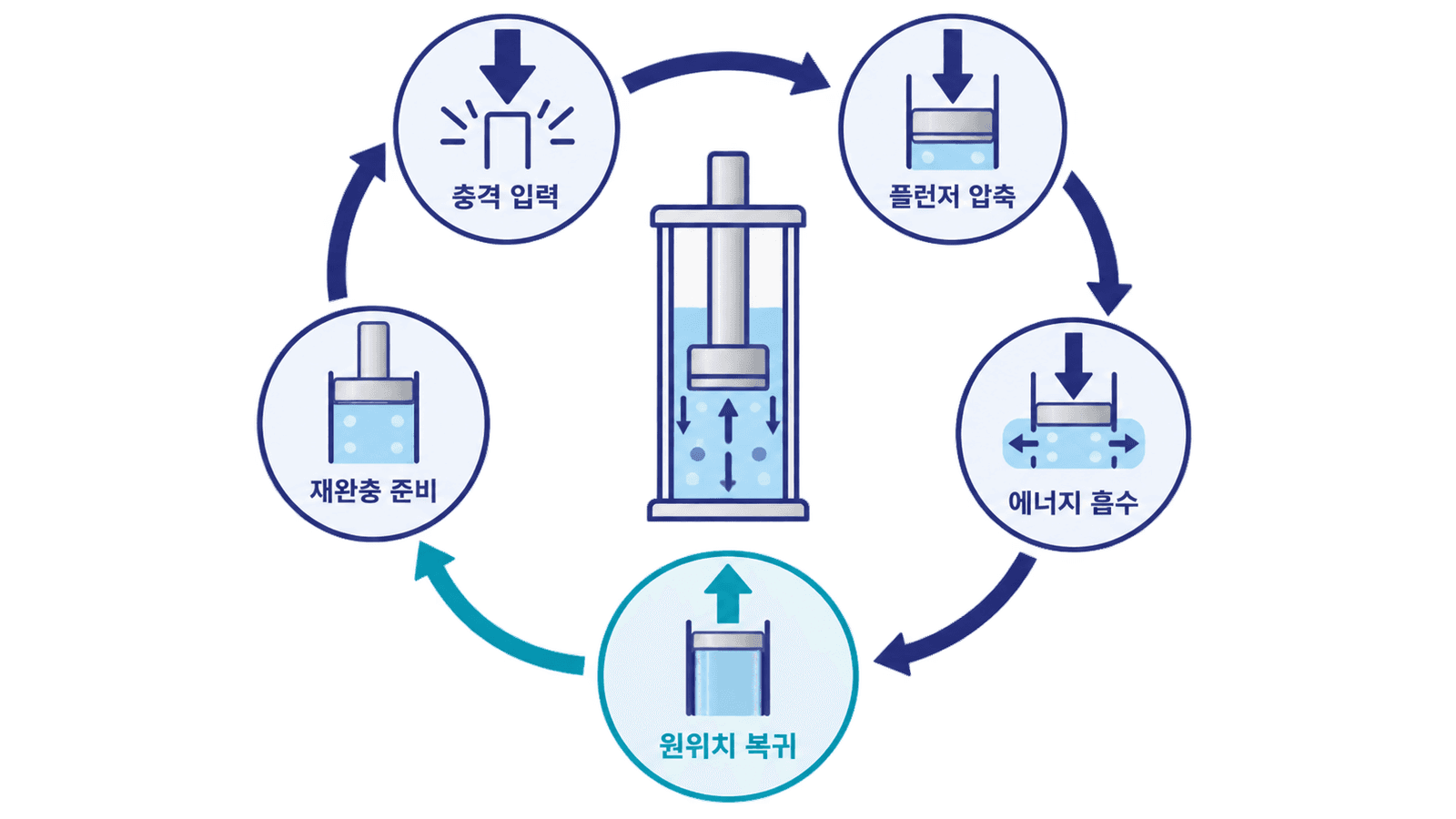
An oil buffer reduces energy through internal fluid resistance when it receives an impact. What matters is not only the moment of compression.
After compression, the plunger must return to its original position so that it can provide cushioning again during the next operation. If the return is slow or stops midway, this should be regarded as degraded performance even if there is no significant visible leakage.
The following conditions are checked together on site.
- Whether the plunger has risen fully
- Whether the return after compression is smooth
- Whether the surface has dents, bending, rust, or foreign matter attached
- Whether there are any obstructions around the Buffer
In particular, if the Pit is not kept clean, dust and foreign matter can adhere to the plunger surface, leading to seal damage or poor return. Leakage is often the visible result, while the cause may be an obstructed stroke or the installation condition.
Available Stroke Should Be Checked Before External Appearance
Stroke is the clearance that allows the Buffer to be physically compressed. If there is insufficient stroke, the impact absorption range is shortened, making it difficult for the Buffer to operate as designed.
A commonly overlooked issue on site is the surrounding conditions rather than the Buffer itself. Reinforcing materials on the Pit floor, temporarily stored items, piping, cables, or mounting brackets may obstruct movement.
In addition, if the fastening position changes or the support structure is modified after replacement work, the actual operating clearance may differ even when the same product is used.
The following inspection sequence is practical.
| Inspection item | On-site assessment point |
|---|---|
| Stroke clearance | Check whether there is sufficient space for the plunger to be compressed. |
| Surrounding interference | Check that brackets, wiring, foreign matter, or items stored in the Pit do not obstruct movement. |
| Support condition | Check whether the base is unstable or tilted. |
| Contact position | Check whether the contact point on the car or Counterweight (CWT) side is aligned with the centre of the Buffer. |
Simply wiping away leakage when the stroke is insufficient leaves the problem unresolved. When assessing cushioning performance, the first question should not be “Is oil leaking?” but “Is there space for compression and are the conditions suitable for return?”
Delayed Return Is an Important Sign When Considering Replacement
An oil buffer may return slowly after compression. However, it requires inspection if the return is abnormally slow, stops midway, or rises only when moved by hand.
Delayed return can result from various causes, including the condition of the internal fluid, seal friction, plunger contamination, deformation, or tilted installation. Rather than conclusively determining the cause on site, it is safer to assess the Buffer based on its functional condition.
For the following conditions, it is advisable to keep records and consider replacement or a detailed inspection.
- Return to the original position after compression is inconsistent.
- Scratches or corrosion are visible on the plunger surface.
- There are signs of binding or uneven wear during return.
- Operation feels heavy even when visible leakage is minor.
Because a Buffer is not a component that operates frequently under normal conditions, abnormalities may be difficult to notice during elevator operation. This is why a brief check during periodic inspection is important.
Installation Verticality and Centre Alignment Also Affect Function
An oil buffer is installed on the assumption that loads will be applied vertically. If it is repeatedly compressed while tilted, uneven loads are applied to the plunger and cylinder, which may lead to seal damage or poor return.
After replacement, the installation position must be checked, not merely whether the product itself is new. If the base is not level or the anchors are fastened unevenly, the tilt may increase over time.
The on-site inspection points are straightforward.
- The Buffer is securely fixed to the floor.
- The centre of the plunger and the centre of the contact point are not significantly misaligned.
- The anchors and brackets have no looseness or deformation.
- There are no signs of cracking or subsidence on the Pit floor.
Buffers with different structures, such as PU buffers, also require checks of their installation condition and contact position. However, because an oil buffer operates through the combined action of fluid, seals, and plunger return, checking the return condition carries greater importance.
Replacement Decisions Consider Leakage, Stroke, and Return Together
It is reasonable to assess several signs together rather than determining oil buffer replacement based on a single symptom.
Obvious leakage naturally requires action. However, even if leakage is minor, the cushioning function is difficult to trust when sufficient stroke cannot be secured or return is poor. Conversely, surface contamination can sometimes appear to be leakage, so the condition must be checked again after cleaning.
In practical terms, the criteria can be organised as follows.
| Condition | Recommended response |
|---|---|
| Minor contamination | Clean, recheck, and record the condition. |
| Suspected leakage | Identify and separate surrounding sources of contamination, then conduct follow-up inspections. |
| Insufficient stroke | Adjust surrounding interference and installation conditions first. |
| Poor return | Consider a detailed inspection or replacement. |
| Tilting or centre misalignment | Consider reinstallation or correction of the support. |
For the oil buffers and PU buffers handled by D&D Co., Ltd., selecting products suited to on-site conditions and confirming their installation are also important. Before replacing a product, it is necessary to check the elevator type, load conditions, installation space, existing certification documents, and maintenance history together.
A Buffer is a component that normally stands quietly in the Pit. However, under abnormal operating conditions, it is responsible for the final safety zone. Checking for leakage is an important starting point, but it is not the whole basis for deciding on replacement. Checking the available stroke, return condition, and installation verticality together provides an inspection that more closely reflects the actual safety function.
Frequently asked questions
- Should an oil buffer be replaced immediately if there are oil stains?
- Oil stains are an important sign of abnormality. However, it is advisable to determine whether they are caused by surrounding contamination or actual leakage, inspect the stroke and return condition as well, and then decide the scope of action.
- Could replacement be necessary even if there is almost no leakage?
- Yes. If the plunger returns slowly or stops midway, sufficient stroke is unavailable, or the installation is tilted, degraded performance should be suspected even when visible leakage is minor.
- Should the return condition of a PU buffer also be checked like that of an oil buffer?
- A PU buffer must also be checked for deformation, cracks, contact position, and fastening condition. However, because an oil buffer has a fluid-and-plunger structure, leakage and delayed return are examined more closely.
- What information should be prepared on site before replacement?
- Preparing the existing Buffer specifications, certification documents, installation photographs, Pit dimensions, elevator load conditions, and recent inspection history enables more accurate product selection and replacement decisions.
Parts covered in this article
Products mentioned above, matched against our catalog.
Sources
- [1]국가법령정보센터 - 승강기 안전관리법law.go.kr
- [2]한국승강기안전공단koelsa.or.kr
- [3]국가법령정보센터 - 승강기 안전관리법 시행규칙law.go.kr
Need to check whether it fits your site?
Tell us the model and site conditions — our team will confirm the specification and send a quote together with certificates and test reports.
