
Translated from the Korean original. Read the original
Safety Parts for Elevators Over 21 Years: Replacement Planning
· 4 min read
- Aging elevators
- Overspeed Governor
- Emergency stopping device
- Buffer
- Replacement deadline
- Precision safety inspection

Key points
- For elevators 21 years old or older, maintenance plans should shift to focus on proactive replacement and documentation management.
- It is advisable to manage the Overspeed Governor, emergency stopping device, and Buffer separately according to each component's operating principle and deterioration factors.
- For buildings with multiple elevators, it is practical to establish annual replacement priorities based on inspection schedules and budget constraints.
- When replacing safety components, it is advisable to prepare product conformity verification documents, such as certificates, manuals, drawings, and photographs, starting from the quotation stage.
- Management records for each elevator should be continuously updated by linking routine inspections, precision safety inspections, and major component replacement histories.
⚠ CautionThis article explains general inspection criteria. For maintenance decisions on a specific installation, please also check that model’s manual and inspection criteria.
As ageing elevators accumulate operating cycles and exposure to their operating environments, variations in the performance of their safety parts may increase. In particular, if stricter replacement deadlines for safety parts in elevators that have been in use for 21 years or more are discussed, maintenance planning must shift from simply responding to failures to focusing on preventive replacement and evidence management.
Why Elevators Over 21 Years Old Require Separate Management
As time passes after an elevator is installed, mechanical component wear, changes in lubrication conditions, corrosion, accumulated vibration, and discontinued parts may arise together.
In addition to faults that are immediately identified during periodic inspections, the reliability of safety devices that must perform their intended functions in an accident becomes important.
The Overspeed Governor, Safety Gear, and Buffer are not usually noticeable during normal operation, but they determine passenger safety in cases of overspeed, fall hazards, and final stopping conditions.
Therefore, when managing ageing elevators, it is not enough to determine only that “the elevator is currently operational.” Manufacturer documentation, inspection history, component condition, and the feasibility of replacement must also be reviewed.
Inspection Considerations for Each Key Safety Part
Because safety parts serve different functions, it is difficult to assess them according to the same criteria. Maintenance companies should manage them separately according to each component’s operating principle and deterioration factors.
| Component | Main function | Items to check as it ages |
|---|---|---|
| Overspeed Governor | Detects abnormal car speed and initiates Safety Gear operation | Wear at rope contact points, variation in operating speed, seal condition |
| Safety Gear | Grips the Guide rail to stop the car | Shoe wear, linkage operation, compatibility with rail condition |
| Buffer | Absorbs impact at the final position | Oil leakage, return condition, deformation of compression section, installation height |
Because an Overspeed Governor detects overspeed, the condition of its rope groove, rotating components, and trip mechanism is important. When applying Overspeed Governors such as DND-GV-002 and DND-GV-003, the certificate, installation requirements, and operating conditions for the relevant model must be checked against site conditions.
The Safety Gear performs the actual stopping action after receiving the signal from the Overspeed Governor. For models such as DD-SG6000B, DD-SG8000B, and DD-SG12000B, the applicable load and site conditions are important, so they must not be selected merely by matching dimensions.
Oil Buffers and PU Buffers have different characteristics. Oil Buffers must be carefully checked for oil leakage and return condition, while PU Buffers must be checked for compression deformation, cracks, and hardening.
Impact of Replacement Deadline Discussions on Maintenance Budgets
If discussions move towards stricter replacement deadlines, building managers must establish medium- and long-term replacement budgets rather than treating the work as a one-off repair expense.
This is because the Overspeed Governor, Safety Gear, Buffer, Electronic Interlock, Sheave, and rope-related components in a single ageing elevator may all need to be reviewed at the same time.
In particular, buildings with multiple elevators may face greater scheduling and budgetary burdens if their inspection dates overlap. A practical approach is to divide priorities by year.
Priorities may be reviewed in the following order.
- Elevators with a history of inspection findings or conditional assessments
- Elevators that have been in use for a long time and operate frequently
- Elevators with discontinued parts or for which certificates are difficult to obtain
- Components that repeatedly show visible abnormalities such as oil leakage, wear, or deformation
- Sites with high passenger volumes where shutdowns generate significant complaints
In such cases, maintenance companies should explain which risk factors make replacement necessary, rather than merely communicating the conclusion that “replacement is required.” Based on that explanation, managers can prepare for budget approval and notifications to occupants.
Document Preparation Becomes Key to Inspection Readiness
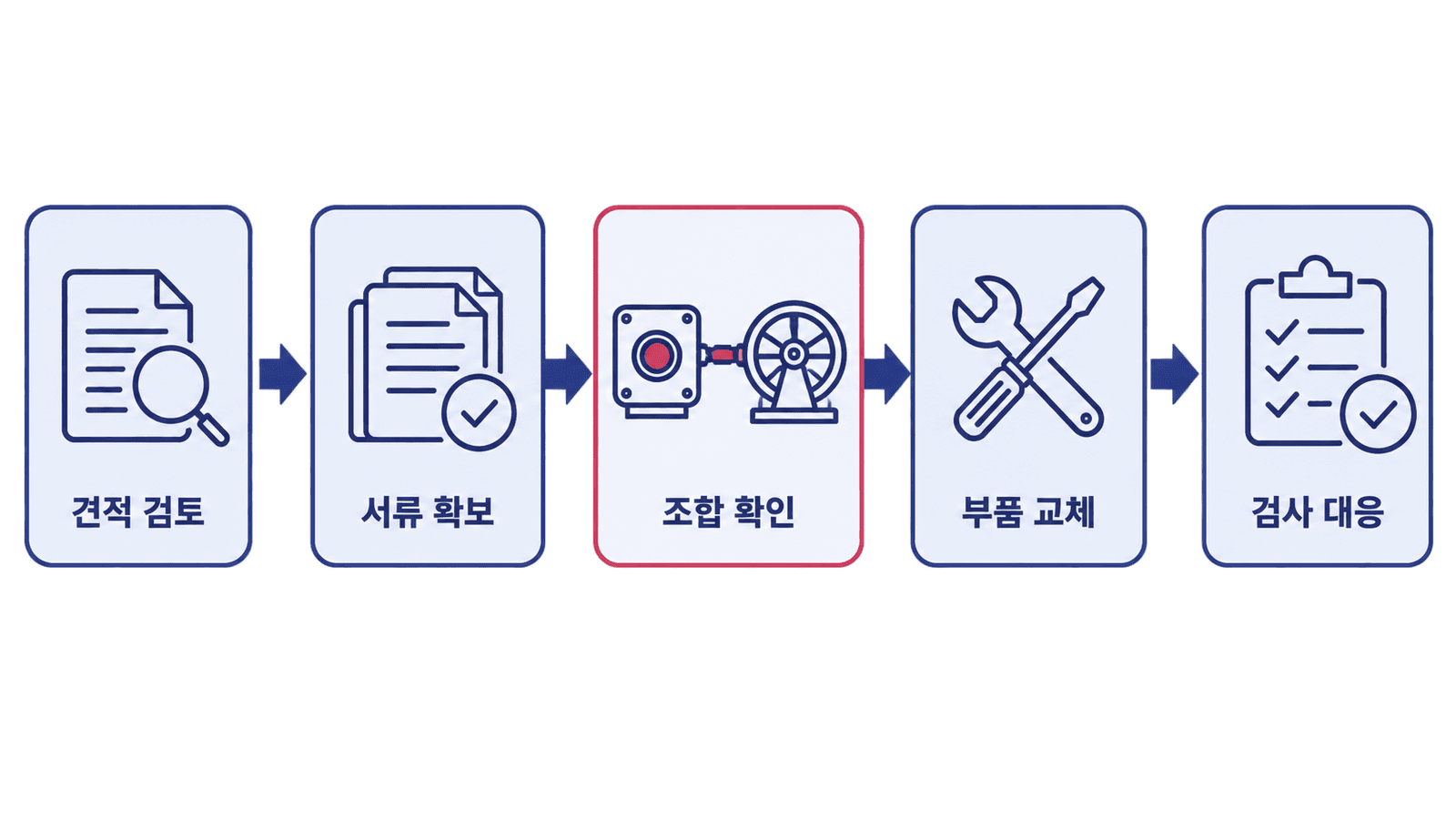
Replacing safety parts does not end with on-site installation. Documents that verify product suitability are important when preparing for inspections.
The basic materials to check include product certificates, test report-related materials, installation manuals, drawings, model names, serial numbers, application ranges, and photographs taken before and after replacement.
Because the Safety Gear and Overspeed Governor operate in conjunction with each other, the suitability of their combination must also be checked. Existing specifications and new component specifications may differ at the site, so a review is required before replacement.
It is better to prepare documents during the quotation stage than to collect them after the work has been completed. If certificates are obtained late or a model name differs from the site records, the inspection schedule may be delayed.
Parts suppliers such as D&D must be able to provide documents required at maintenance sites, including product information, certificates, after-sales service manuals, and standard price notices. However, the final decision on application must be made by reviewing both site conditions and inspection criteria.
Preventive Management Checklist
Managing ageing elevators is difficult to complete with a single inspection. Periodic inspections, detailed safety inspections, and major component replacement histories must be connected into a single process.
Maintenance companies should regularly update the following items.
- Installation year and major component replacement year for each elevator
- Model names and serial numbers of the Overspeed Governor, Safety Gear, and Buffer
- Inspection findings and dates when corrective actions were completed
- Photographic records and signs of abnormalities for each component
- Storage locations for certificates, manuals, and drawings
- Discontinuation status and possible replacement models
Based on these materials, building managers can identify replacement candidates in advance of the next inspection. Maintenance companies should propose schedules that take into account component procurement lead times and available working hours.
Discussions on stricter replacement deadlines for safety parts in elevators that have been in use for 21 years or more should not be viewed solely as a burden on the industry. It is important to use them as an opportunity to identify the risks of ageing equipment in advance and prepare the necessary parts and documents on time. Preventive management is particularly valuable for components that must operate in an accident, such as the Overspeed Governor, Safety Gear, and Buffer.
Frequently asked questions
- Must all safety parts in an elevator over 21 years old be replaced immediately?
- Rather than assuming that all parts must be replaced immediately and uniformly, the current inspection criteria, site conditions, component history, and availability of certificates should be reviewed together. However, given the discussions on stricter requirements, preliminary surveys and budget allocation are necessary.
- Can the Overspeed Governor and Safety Gear be replaced separately?
- Because the two devices operate in conjunction with each other, the suitability of their combination must be checked. It is advisable to determine the scope of replacement after reviewing the existing specifications, rated speed, applicable load, and rail conditions together.
- How do the inspection points differ between Oil Buffers and PU Buffers?
- For Oil Buffers, the focus is on oil leakage, return condition, and installation condition. For PU Buffers, it is important to check for cracks, compression deformation, hardening, and fastening condition.
- What documents should be prepared before an inspection?
- It is advisable to prepare product certificates, installation manuals, drawings, model names and serial numbers, photographs taken before and after replacement, and records of corrective actions for inspection findings. Checking whether the documents can be obtained during the quotation stage can reduce scheduling delays.
Parts covered in this article
Products mentioned above, matched against our catalog.
Sources
- [1]KOTRA Ombudsman - 승강기 안전부품 교체기한 관련 규제 정보ombudsman.kotra.or.kr
- [2]국가법령정보센터 - 승강기 안전관리법law.go.kr
- [3]국가법령정보센터 - 승강기 안전관리법 시행규칙law.go.kr
Need to check whether it fits your site?
Tell us the model and site conditions — our team will confirm the specification and send a quote together with certificates and test reports.