
Heavy-load Elevator Safety Gear: DD-SG12000B·DD-SG30000B Criteria
· 12 min read
- Heavy-load elevators
- Freight elevators
- Safety Gear
- DD-SG12000B
- DD-SG30000B
- Guide rail
- Technical review

Key points
- Safety Gear for heavy-load elevators requires distinguishing rated load from the mass to be braked and reviewing speed, rails, and installation conditions together.
- DD-SG12000B and DD-SG30000B must be compared using model-specific technical documentation and application ranges; the numbers in their model names alone cannot establish permissible loads or interchangeability.
- The development of DD-SG12000B as a 12톤 Safety Gear in 2018 is a starting point for review; whether the currently proposed specifications match site conditions must be checked separately.
- Double-deck and triple-deck delivery records can be used only after checking the system configuration and the meaning of the load at the time; those figures cannot be transferred to individual devices as their permissible loads.
- The availability of a test tower capable of testing 12톤 elevators and the availability of test results for the model and site conditions concerned must be checked separately.
⚠ CautionThis article explains general inspection criteria. For maintenance decisions on a specific installation, please also check that model’s manual and inspection criteria.
Contents▾
- 1.Model comparison begins with defining the load
- 2.Distinguish DD-SG12000B and DD-SG30000B through documentation
- 3.Rails and device arrangement change braking conditions
- 4.Examine the force transmission path before installation space
- 5.Distinguish test infrastructure from test evidence for the model concerned
- 6.Delivery history provides a basis for asking about system conditions
- 7.Describe site conditions in more detail than model names in requests for quotation
- 8.The review is complete only when documentation connects to the actual supplied product
- 9.Record the model name and application conditions together in the selection conclusion
Model comparison begins with defining the load
Distinguish the weight of the freight from what must be braked
When reviewing Safety Gear for a freight elevator, the first point to clarify is what the load means. It is difficult to determine the applicability of Safety Gear from the carrying capacity stated in a request for quotation alone.
Rated load refers to the load of the freight or other items being carried. The mass of the car itself and attached structures is separate, so these must also be considered when reviewing the conditions under which the device must brake.
If the car's own weight has changed because of floor reinforcement or additional equipment, check whether the mass values in the existing drawings reflect the current condition. Mixing values from the original design with those after modification changes the starting point for comparison.
Check the scope of the mass calculation and how it is expressed against the device's technical documentation. Even if different documents use the same word, 'load', do not assume that they include the same items.
Consider speed and transport conditions together
Safety Gear generates braking force through contact with the Guide rail in an emergency. Its application review is therefore affected by the speed at activation and braking conditions as well as mass.
Even with the same freight capacity, the review outcome may differ depending on the car's own weight, speed, rail configuration, and installation structure. The classification 'for heavy loads' narrows the candidates for review; it does not establish suitability for an individual site.
Freight distribution also needs to be checked. If uneven loading is expected, review the forces transmitted to the car frame and rails from a design perspective, and relate the results to the device selection conditions.
At the quotation stage, it is advisable to distinguish confirmed values from estimates when providing information. Entering an unverified car weight as a confirmed value can carry the same error into subsequent model comparisons and installation reviews.
Distinguish DD-SG12000B and DD-SG30000B through documentation
Read development history separately from the current application range
D&D's Safety Gear products include DD-SG12000B and DD-SG30000B. DD-SG12000B has a history of development as a 12톤 Safety Gear in 2018.
This history provides a starting point for reviewing the product. However, the application documentation must be checked to determine which load definition in the current quotation corresponds to the '12톤' used at the time of development.
For DD-SG30000B as well, the model name alone does not reveal its rated load, mass to be braked, or permissible speed. A larger number also provides no basis for treating it as a higher-capacity substitute under all conditions.
The practical basis for distinguishing models is the verified application range for the type concerned. A comparison is possible only when the currently supplied specifications and site conditions can be checked against the same items.
Compare answers to the same questions
| Comparison item | What to check when reviewing DD-SG12000B | What to check when reviewing DD-SG30000B |
|---|---|---|
| Confirmed product information | Relationship between the 2018 development of a 12톤 device and the currently supplied specifications | Currently supplied specifications and application range |
| Load conditions | Mass definition in the technical documentation and the calculated site value | Calculated site value using the same mass definition |
| Speed and rail conditions | Applicable speed and rail combinations | Applicable speed and rail combinations |
| Installation conditions | Suitability of mounting connections, actuation mechanism, and installation space | Suitability of mounting connections, actuation mechanism, and installation space |
| Documents to check | Application and test documentation that identifies the type concerned | Application and test documentation that identifies the type concerned |
Do not fill gaps in the comparison table with assumptions. When obtaining a manufacturer's response, it is important to request that the document record the site conditions used for the assessment along with the conclusion that the device 'can be used'.
Rails and device arrangement change braking conditions
The rail is the mating component for the device
Safety Gear operation depends on contact with the Guide rail. Changes in rail profile and contact surface condition may also change how the device is installed and the braking conditions.
Checking the rail's external dimensions alone is insufficient. Check the rail specifications, surface condition, and contact conditions required by the application documentation, and compare them with the rails actually installed.
For existing equipment, also examine rail wear, damage, and substances on the surface. The fact that normal operation is possible does not by itself establish that the contact conditions during emergency braking are suitable.
When removing contamination from braking surfaces, avoid changing their condition through unapproved grinding or chemical use. First check the permitted maintenance methods and application conditions so that the subsequent suitability assessment remains valid.
Do not calculate capacity directly from the number of rails
Heavy-load installations may have complex rail and safety device arrangements. Do not calculate that the permissible load increases in proportion to the number of rails or devices.
When each device activates and how much force it shares are affected by the linkage and the behavior of the structure. A symmetrical arrangement in a drawing does not establish equal load sharing in practice.
Both the individual devices and the overall arrangement must be checked. After confirming each device's application range, review whether the system in which those devices are arranged can operate as intended.
In particular, when replacing an existing model with another model, do not end the review after matching installation positions. Identify changes in actuation direction, connection method, and rail contact position, and incorporate them into the design review.
Examine the force transmission path before installation space
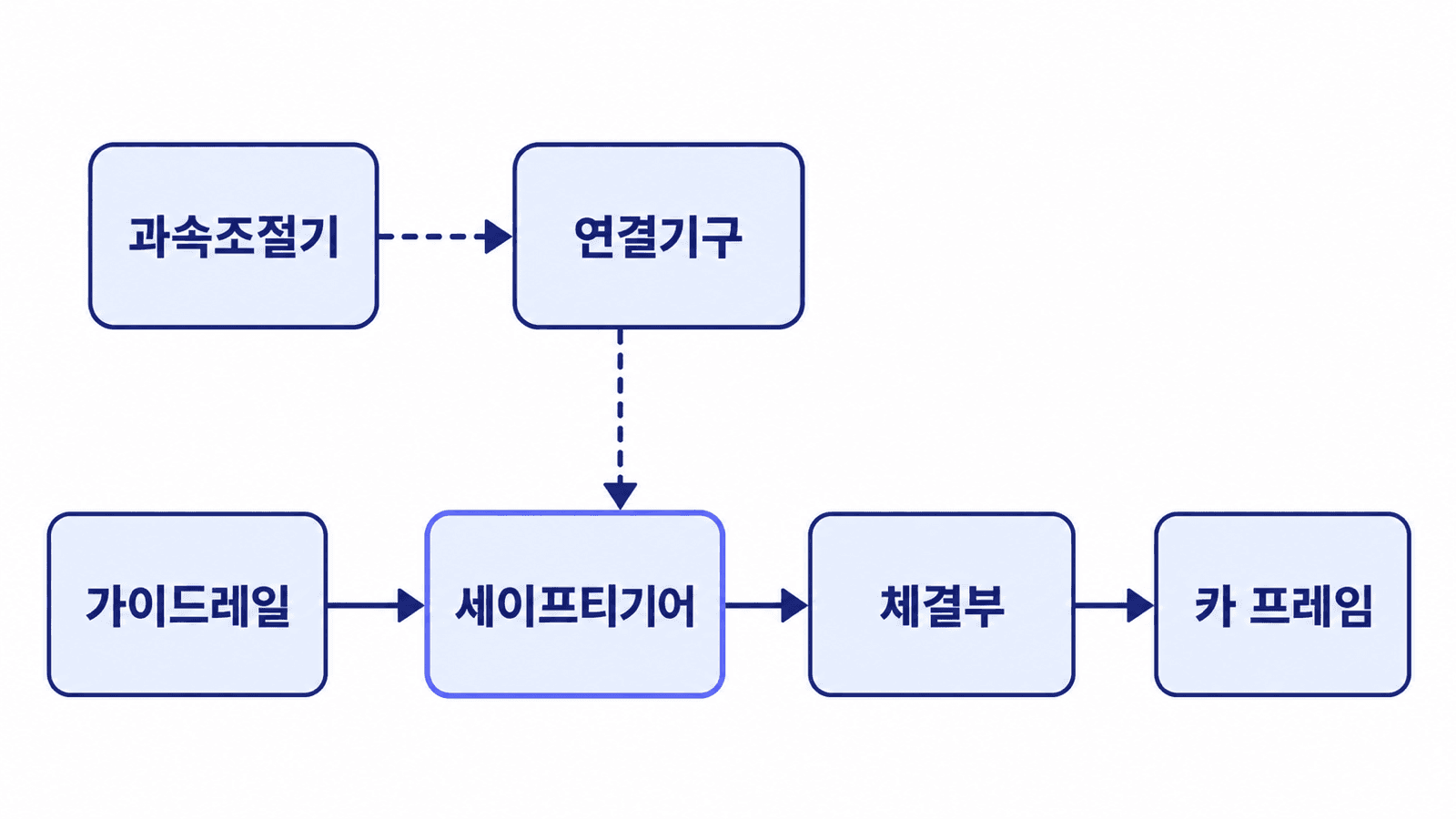
Check through to the mounting connections and car frame
When Safety Gear generates braking force at the rail, that force is transmitted to the device's mounting connections and the car frame. The application range of the device itself and the suitability of its supporting structure must be checked together.
The fact that the device's external dimensions fit within the installation space shows only that assembly is possible. Whether the mounting positions, contact surfaces, and supporting structure can transmit the forces generated during operation requires a separate design review.
A replacement proposal that uses existing mounting holes or adds connecting components requires revised drawings. Establish the reviewed installation conditions first, rather than using the outcome of adjustments made during site installation as the basis.
If a model change alters the device's position or mounting method, also check for interference with surrounding components. Examine not only the space during normal operation but also the movement range of the actuation mechanism and access space for inspection.
Check the connection conditions of the actuation mechanism
Safety Gear must be reviewed as part of the actuation system connected to the Overspeed Governor, linkage, and other components. Even if the device itself is suitable, the intended operation cannot readily be expected if the linkage cannot transmit the required movement.
Check the actuation direction, travel, and connection geometry required by each model, and compare them with the existing mechanism. Use values from the documentation for the product concerned; do not transfer installation experience from another model directly.
Play and interference in the actuation mechanism must also be included in post-installation checks. If multiple devices are connected, define inspection positions and methods that allow the transmission of movement to each device to be checked.
Also distinguish whether the quotation covers only the device itself or includes connecting components and structural modifications. If the scope of supply is unclear, the need for additional design work may become apparent only after the components arrive.
Distinguish test infrastructure from test evidence for the model concerned
Check the facility's testing capabilities
D&D's test tower, completed in 2025, can test 12톤 elevators. When reviewing heavy-load products, the availability of infrastructure for testing is information worth checking.
However, a facility's testing capabilities do not mean that verification has been completed for every model and every installation combination. Distinguish a statement that testing can be performed in the tower from a statement that a particular product has been tested under particular conditions.
When reviewing DD-SG12000B and DD-SG30000B, first identify the items that need to be checked. Then examine the configurations and conditions under which the submitted test documentation verified those items.
Comparing only the scale of test facilities can easily overlook questions needed for site application. The actual review requires a correspondence between the identification information for the tested item and the intended site application.
Read test results together with their conditions
| Item to check | What to read in the documentation | What to compare for site application |
|---|---|---|
| Test item | Model, type, and configuration of the test specimen | Whether it matches the product actually supplied |
| Mass and speed | Conditions and definitions used in the test | Calculated site values and application range |
| Rails and arrangement | Rail specifications and device configuration | Site rails and installation arrangement |
| Results and scope | Items verified and application limitations | Scope within which the results can support selection |
If the test documentation contains conditions that differ from those at the site, retain those differences in the review list. Request the manufacturer's basis for applicability and identify the points requiring further checks.
Documentation that explains the required conditions matters more than a statement that more tests have been performed. Along with checking whether results exist, determine which parts of the current selection proposal those results support.
Delivery history provides a basis for asking about system conditions
Read double-deck and triple-deck figures separately
D&D has a delivery record for a 12톤 double-deck, 10-rail system in 2019 and a 10-rail triple-deck system with a maximum load of 137.5톤 in 2023.
These records provide a starting point for checking experience with complex heavy-load site configurations. However, the loads stated in those records cannot be assigned to individual Safety Gear devices as their permissible loads.
First, check what the load stated at the time referred to. Then examine the system configuration, including device type and quantity, rail arrangement, and connection structure, to enable comparison with the current site.
The stated delivery records alone also cannot establish whether DD-SG12000B or DD-SG30000B was used. To use a delivery as a reference for a specific model, documentation linking that delivery to the product is required.
Identify differences between similar sites
When receiving a similar delivery example, record differences as well as similarities. Even if freight capacities are similar, differences in car weight, speed, rail configuration, or car frame structure change the content of the application review.
In particular, when applying experience from double-deck or triple-deck systems to an ordinary freight elevator, check the structural differences. The numbers of decks and rails describe the equipment configuration; they are not a conversion formula that replaces model selection.
Maintenance documentation after delivery is also worth checking. However, operating experience from another site is a reference for supplementing inspection items; it does not replace application documentation and installation review for the current site.
Technical comparison remains possible even when the client or project name is difficult to disclose. What is needed is documentation sufficient to check the model, configuration, and application conditions, rather than the name itself.
Describe site conditions in more detail than model names in requests for quotation
Provide comparable input values
A request stating only 'quotation for heavy-load Safety Gear' makes it difficult for the supplier to assess the application range. Even when listing candidate models, provide the site conditions for which those models are to be reviewed.
New installations and replacements also require different documentation. For new installations, organize the design conditions. For replacements, explain the current conditions by adding the actual installation state and modification history to the existing nameplate information and drawings.
| Request item | Information to enter | How to handle uncertainty |
|---|---|---|
| Load | Rated load, car weight, and the basis for each value | Identify unconfirmed items and the person responsible for checking them |
| Operating conditions | Speed and required application conditions | Identify differences between drawings and equipment documentation |
| Rails | Type, specifications, arrangement, and current condition | Attach identification documentation and site inspection findings |
| Installation structure | Drawings of the car frame, mounting connections, and actuation mechanism | Identify missing dimensions and planned modifications |
| Candidate products | Model names and identification information for existing products | State whether the review concerns a replacement or a new selection |
| Required documentation | Basis for application, installation documentation, and scope of supply | Specify the documents to be checked before contracting |
Photographs help explain rails and installation conditions, but they are difficult to use as a basis for establishing mass or material. Mark differences between drawings and photographs and retain them as items requiring further checks.
Read the quotation's assumptions and exclusions
Quotations for the same model may include different connecting components and scopes of technical review. Before comparing prices, check the installation proposal on which each quotation is based.
Also identify items that require review if site conditions change. If the car weight or rail specifications change but the selection conclusion from the original quotation is retained, the basis for the assessment may no longer match the actual equipment.
The review is complete only when documentation connects to the actual supplied product
Check the type and document revisions as well as the model name
Before ordering, check that the product identification information in the proposal, application documentation, and installation drawings is consistent. Even with the same model name, further checks are needed if the documents describe different accessory configurations or installation conditions.
For certification documentation as well, check the scope that relates to the model and supplied specifications concerned. A company's history of obtaining certification does not mean that all the application evidence for the currently proposed combination has been verified.
If drawings have been revised during the technical review, designate the final version for use and record the reasons for the changes. If earlier drawings also remain on site, installers and reviewers may make assessments based on different conditions.
At delivery, compare the nameplate, accessories, and enclosed documents with the order details. Product identification must connect through to installation documentation so that the selection conditions can also be traced during subsequent maintenance.
Hand over post-installation checks and records
After installation, check the required items, including mounting condition, linkage movement, and interference, in accordance with the established work and verification procedures. If an operational test is required, it must also be performed in accordance with the manufacturer's procedures and the site work plan.
If site conditions differ from the documentation, resolve those differences before completing the checks. Do not omit mismatches in application conditions from acceptance records simply because installation appears complete.
In the records handed over to the maintenance company, link the model and identification information, final drawings, application conditions, and post-installation check results. These provide a basis for review when rails or the car structure are subsequently modified.
Records that preserve the assumptions behind selection are more useful than those that merely state that a device was replaced. They allow the next person responsible to assess first whether site conditions remain the same, even when reordering the same model.
Record the model name and application conditions together in the selection conclusion
Do not include unverified conditions in the conclusion
Distinguishing DD-SG12000B from DD-SG30000B involves more than comparing the numbers in their model names. Align the load definitions and compare speed, rails, arrangement, mounting connections, and actuation mechanism conditions.
The information currently presented does not include specifications that allow a direct comparison of the two products' full application ranges. Therefore, this information alone cannot establish which model is suitable for a particular freight elevator or whether they are interchangeable.
In practice, record both the intended application and the basis for the assessment in the selection conclusion. It must be clear which site conditions were used to review which type, and which documentation confirmed its suitability.
Resolve remaining questions before ordering
Development history shows the product's background, delivery history shows system experience, and test documentation shows verification results under stated conditions. Using each for its intended role clarifies the basis for model selection.
If unconfirmed masses, unidentified rails, or unverified installation modifications remain, assign responsibility and a method for checking them. It is advisable to finalize the order conditions after receiving an application response and drawings that reflect the findings.
The required conclusion when selecting Safety Gear for a heavy-load elevator is that the product and configuration have been confirmed to match site conditions. This must connect through to the documentation and the actual supplied product so that it can serve as a basis for installation and maintenance decisions.
Frequently asked questions
- How should Safety Gear models be distinguished and reviewed for freight or heavy-load elevators?
- Distinguish rated load from car weight to establish the conditions for what must be braked, then compare speed, rails, device arrangement, and installation structure with each model's application documentation. DD-SG12000B and DD-SG30000B must also be compared by presenting the same site conditions and obtaining the basis for their applicability.
- Can an order be placed if the quotation contains only the model name and a statement that it is 'applicable'?
- First check the load, speed, rail, and installation conditions on which that response is based. It is advisable to connect the application documentation, installation drawings, and scope of supply, resolve unconfirmed conditions, and then finalize the order details.
- What should be prepared first if the existing Safety Gear nameplate is unreadable?
- First locate equipment drawings, previous replacement records, and component supply documents to identify the product. Prepare site photographs and installation dimensions as supplementary information, but do not establish the existing model or a replacement solely because their external appearance is similar.
- Can the delivery record with a maximum load of 137.5톤 be used as performance documentation for DD-SG30000B?
- The stated record alone cannot be used for that purpose. Documentation linking the model used in that delivery, the device configuration, and the load definition is required, and the system load must not be interpreted as the permissible load of an individual device.
- If a plan to reinforce the car floor is added during product review, must selection be repeated?
- The validity of the existing selection must be rechecked to reflect the changes in car weight and structural conditions caused by the reinforcement. The model does not necessarily have to change, but evidence that it remains applicable under the changed conditions and revised drawings must be retained.
Parts covered in this article
Products mentioned above, matched against our catalog.
Need to check whether it fits your site?
Tell us the model and site conditions — our team will confirm the specification and send a quote together with certificates and test reports.