Improved the manually performed emergency stop device setting before shipment to an automated method
Secured product reliability before shipment through precision assembly…reduced working time by 75% compared with before
D&D (CEO Lee Hyo-yong) developed a “high-reliability Safety Plank assembly and inspection jig (JIG) (hereinafter referred to as inspection jig)” that can quickly and accurately install an elevator emergency stop device (Safety device), and is working on quality improvement. It is expected to dramatically reduce product defect rates that had varied at construction sites depending on the skill level of installation personnel.
Felt the limitations of manual setting, for which it was difficult to secure reliability
The emergency stop device, which stops the car if an elevator falls, can only be judged pass or fail after installation has been completed on site. In addition, the brake operates normally only when the devices engage each rail simultaneously, and a high level of skill is required to assemble the product accurately. This is because if each position is even slightly misaligned or the force gripping the rail differs, the frame can become distorted.
D&D had also worked to reduce the time, manpower and cost required for A/S, but because reliability verification was difficult even when products were shipped after proper setting, there were cases in which the company had to assume responsibility even for problems that occurred on site. Process improvement was needed to improve quality and increase product reliability.
No Sung-seop, Deputy General Manager of D&D’s Quality Control Team, said, “Previously, after setting up temporary rails, we hung a scale on a forklift and performed setting while measuring the pulling force, but because a person performed the work manually, precision was low. We came to consider developing an inspection jig in order to identify defect cases caused by settings that did not match on-site installation conditions.”
With development of the inspection jig, even 4 rails and high loads of 12 tons can be adjusted to individual sites
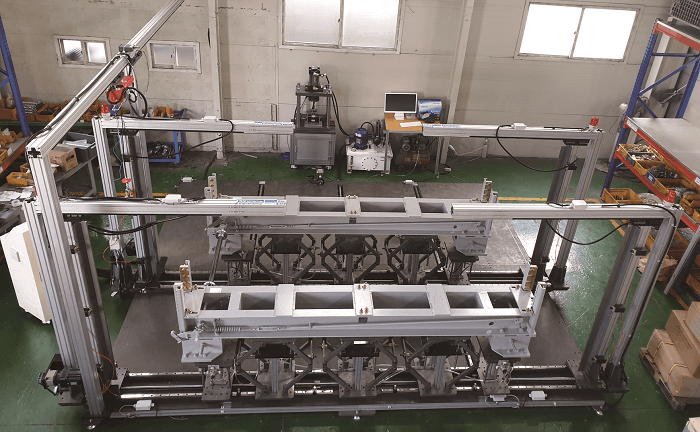
Simply put, the process improvement method developed by D&D is based on the principle of seating the device on a fixing jig die and assembling it precisely. It is a method of creating the same conditions as the site where the emergency stop device will be installed on a jig equipped with an LM guide and screw motor, and checking accurate values by simulating a descent under load.
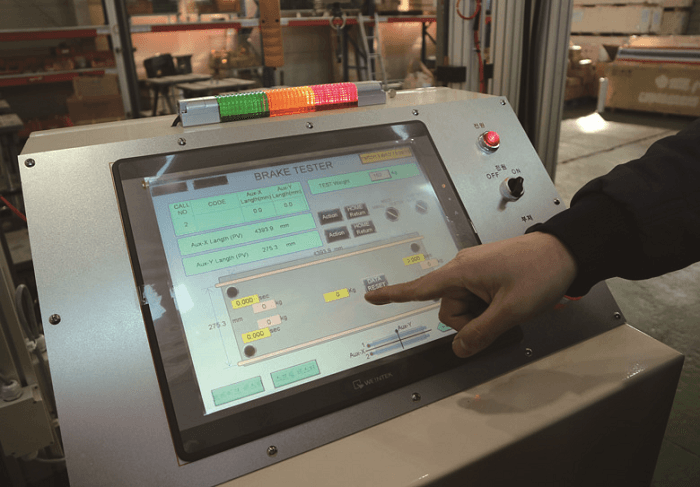
Before shipment, a compression tester is attached to the device on a jig matched to the site conditions to check whether the load value applied to each rail is constant, and sensors attached to the device were designed to light up at the moment the brake shoes engage each rail, making it possible to check the time difference in engagement with each rail. The more accurate the setting, the more constant the load received and the smaller the engagement time error, which can be confirmed visually at once, and all these test values are quantified on a monitor, enabling accurate adjustment.
Deputy General Manager No explained, “With the development of the inspection jig, even 4 rails, which are difficult to adjust, can now be set easily, and real-time monitoring is possible up to a load of 12 tons,” adding, “Like a bungeoppang mold, it has become possible to ship products with uniform quality that matches site conditions.”
The most positive change brought about by the process structure improvement was that quality improved significantly through the accuracy of setting. According to D&D, reliability tests suited to each site’s conditions became possible before delivery, and since last December, not a single defect or A/S request occurred in the 6 sets that were set and shipped using the inspection jig.
The work that had previously taken about 6 hours was also reduced to within 1 hour and 30 minutes, resulting in significant savings in time and cost. The evaluations from site managers that “there is no problem even when the delivered product is installed on the rail as is” were also a major achievement from this process improvement.
“We will continue developing products and processes that reflect voices from the field”
In addition to this inspection jig, D&D is also planning several more products to reduce defect rates. Deputy General Manager No emphasized that the other products under development are also focused on “improving convenience for installation workers” while listening to voices from the field as much as on performance. This is because in the freight device market, which can be called a niche market, evaluations of quality between sites are made as quickly as its special characteristics.
Deputy General Manager No said, “If we had stayed only inside the factory or laboratory, we would not have known field conditions and the difficulties faced by workers well,” adding, “While going out for A/S or visiting new product installation sites, we are considering what is most needed for smooth work and developing products by reflecting the opinions of field personnel.”
In this way, in a device market that had been moving toward competition in large capacity, D&D is presenting a differentiated strategy with the goal of “quality improvement at installation sites.” Through more diverse projects in the future, the company is expected to increase the quality reliability of special devices and elicit positive responses from many site personnel.
<Copyright ⓒ Elevator&Parking Systems Monthly (www.liftasia.com). Unauthorized reproduction and redistribution prohibited>