Pioneering the large-capacity Safety Gear market targeting freight elevators
Dramatically reduced size and weight, enabling application at various sites
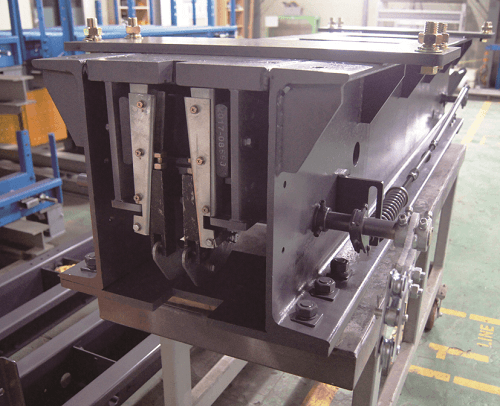
D&D, an elevator parts manufacturer (CEO Lee Hyo-yong), developed a 12-ton progressive Safety Gear (SAFETY GEAR, model name DD-SG12000B) for the first time among Korean SMEs. This has made it possible for small and medium-sized companies in the industry to apply large-capacity Safety Gear of 10 tons or more, which had mainly been used by global companies or large enterprises in their own double-deck and large-capacity elevators. D&D completed certification work at the end of February and began mass production of the product last month.
With D&D’s development of the new product, small and medium-sized elevator companies are expected to be able to move beyond limitations in area and weight when designing elevators. Immediately after the product passed certification testing, inquiries came in from several companies, and a Japanese special elevator company also showed strong interest, including by visiting the factory in person.
CEO Lee Hyo-yong said, “As the capacity of freight elevators has recently increased significantly, safety devices have also been required to deliver higher performance every year, and we came to feel the need for development,” adding, “After about 2 years and 2 months of research, we have launched a 12-ton high-capacity Safety Gear with reduced weight and volume.”
The reason D&D began developing a large-capacity product was requests from customers. With the recent increase in demand for large freight elevators, loading capacity has also been rising, and elevator manufacturers need Safety Gear capable of withstanding heavier loads in line with market changes. Until now, the weight required by customers had been met by connecting two 6- to 8-ton Safety Gears, but this had drawbacks: the car length increased, resulting in many sites where the Pit length was not suitable, and the price and weight also doubled.
By contrast, D&D’s 12-ton Safety Gear significantly reduced length and weight while offering large capacity. In addition to resolving space constraints, the weight reduction can also significantly reduce power consumption. The price is also 40 percent lower than the purchase price of two existing 6-ton Safety Gears, and is expected to help freight elevator manufacturers reduce costs.
For Safety Gear to withstand a 12-ton impact on the rail, spring performance is more important than anything else. D&D also spent the most time maintaining the spring constant value while preparing this product. This is because product reliability and stability can be secured only when the spring constant maintains the same value under the same impact.
However, for large-capacity products that must withstand greater force than low-capacity products, it was not easy to match this value. The development team repeated experiments while changing the type, material, weight, and processing method of the spring, but had difficulty because the constant value continued not to match. To find the cause, the team referred to advice from experts in the elevator industry and mechanical engineering experts at Seoul National University, KAIST, and elsewhere, and as a result was able to successfully develop a product with stable performance.
D&D’s product development team explained, “Even with the same shape, function and performance vary greatly depending on the material, heat treatment, processing method, and other factors,” and “Through numerous tests, we found a form optimized for large capacity, and as a result, we were able to obtain a stable constant value by using a U spring.” In addition, the company improved product completeness through R&D investment, including the introduction and use of a 3D drawing design program for precise parts manufacturing.
The freight elevator field has a smaller market size than general passenger elevators, but production scale is large and prices tend to be high. As the number of large buildings such as mixed-use residential-commercial complexes is steadily increasing, domestic demand for large-capacity Safety Gear is also expected to rise. D&D sees its sales target for the new product this year at around 200 to 300 units, and plans to expand sales channels into overseas markets. As it has steadily exported parts to Japan, an advanced elevator country, and has been recognized for quality, the company is expected to achieve significant results not only in Korea but also in overseas exports.
Meanwhile, D&D believes that, based on the development know-how accumulated during the development process for this 12-ton Safety Gear, it will also be possible to develop products of 15 tons, 18 tons or more. CEO Lee said, “If an environment capable of product development, such as certification testing facilities, is provided, we will be able to introduce even higher-capacity products.”
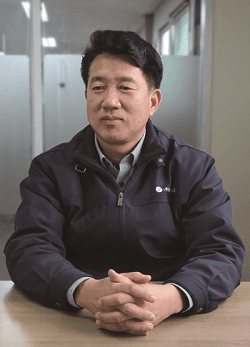
■ Mini Interview_ D&D CEO Lee Hyo-yong
“There is no future for companies that do not invest in product development”
For companies now, product development has become an issue directly connected to survival. CEO Lee said that since founding the company 23 years ago, he had worked to enhance the company’s own strengths and quality. Having entered overseas sales from the early days of the company’s establishment, he became even more firmly convinced of this view.
However, CEO Lee feels regret that Korea’s small and medium-sized elevator industry is not reading this trend of the times.
“Companies, especially manufacturers, have no choice but to fall behind if they do not continuously conduct research and development. Global companies are expanding their influence with their brands and technological capabilities, and even nearby China is continuing innovation after innovation at an enormous pace. Just as the landscape of the industry changed greatly with synchronous motor innovation 10 years ago, another period of major technological change will arrive in the future in areas such as ropes, brakes, and maintenance methods.” As in his warning, the Korean elevator industry’s export competitiveness is declining due to brand and technological capability, and even prices higher than Japan’s, and there are concerns about cost increases caused by expanded domestic regulations and the resulting consumers turning away.
CEO Lee advised, “If SMEs become complacent with public-sector orders and neglect innovation, they may face a situation within several years in which it is difficult to continue the company,” adding, “Companies must first secure product competitiveness through quality improvement and specialized items, and the government must support them with policy support in order to survive in a changing market.”
<Copyright ⓒ Elevator & Parking Systems Monthly (www.liftasia.com). Unauthorized reproduction and redistribution prohibited>


Pioneering the large-capacity Safety Gear market targeting freight elevatorsDramatically reduced size and weight, enabling application at various sites
D&D, an elevator parts manufacturer (CEO Lee Hyo-yong), developed a 12-ton progressive Safety Gear (SAFETY GEAR, model name DD-SG12000B) for the first time among Korean SMEs. This has made it possible for small and medium-sized companies in the industry to apply large-capacity Safety Gear of 10 tons or more, which had mainly been used by global companies or large enterprises in their own double-deck and large-capacity elevators. D&D completed certification work at the end of February and began mass production of the product last month.
With D&D’s development of the new product, small and medium-sized elevator companies are expected to be able to move beyond limitations in area and weight when designing elevators. Immediately after the product passed certification testing, inquiries came in from several companies, and a Japanese special elevator company also showed strong interest, including by visiting the factory in person.
CEO Lee Hyo-yong said, “As the capacity of freight elevators has recently increased significantly, safety devices have also been required to deliver higher performance every year, and we came to feel the need for development,” adding, “After about 2 years and 2 months of research, we have launched a 12-ton high-capacity Safety Gear with reduced weight and volume.”
The reason D&D began developing a large-capacity product was requests from customers. With the recent increase in demand for large freight elevators, loading capacity has also been rising, and elevator manufacturers need Safety Gear capable of withstanding heavier loads in line with market changes. Until now, the weight required by customers had been met by connecting two 6- to 8-ton Safety Gears, but this had drawbacks: the car length increased, resulting in many sites where the Pit length was not suitable, and the price and weight also doubled.
By contrast, D&D’s 12-ton Safety Gear significantly reduced length and weight while offering large capacity. In addition to resolving space constraints, the weight reduction can also significantly reduce power consumption. The price is also 40 percent lower than the purchase price of two existing 6-ton Safety Gears, and is expected to help freight elevator manufacturers reduce costs.
For Safety Gear to withstand a 12-ton impact on the rail, spring performance is more important than anything else. D&D also spent the most time maintaining the spring constant value while preparing this product. This is because product reliability and stability can be secured only when the spring constant maintains the same value under the same impact.
However, for large-capacity products that must withstand greater force than low-capacity products, it was not easy to match this value. The development team repeated experiments while changing the type, material, weight, and processing method of the spring, but had difficulty because the constant value continued not to match. To find the cause, the team referred to advice from experts in the elevator industry and mechanical engineering experts at Seoul National University, KAIST, and elsewhere, and as a result was able to successfully develop a product with stable performance.
D&D’s product development team explained, “Even with the same shape, function and performance vary greatly depending on the material, heat treatment, processing method, and other factors,” and “Through numerous tests, we found a form optimized for large capacity, and as a result, we were able to obtain a stable constant value by using a U spring.” In addition, the company improved product completeness through R&D investment, including the introduction and use of a 3D drawing design program for precise parts manufacturing.
The freight elevator field has a smaller market size than general passenger elevators, but production scale is large and prices tend to be high. As the number of large buildings such as mixed-use residential-commercial complexes is steadily increasing, domestic demand for large-capacity Safety Gear is also expected to rise. D&D sees its sales target for the new product this year at around 200 to 300 units, and plans to expand sales channels into overseas markets. As it has steadily exported parts to Japan, an advanced elevator country, and has been recognized for quality, the company is expected to achieve significant results not only in Korea but also in overseas exports.
Meanwhile, D&D believes that, based on the development know-how accumulated during the development process for this 12-ton Safety Gear, it will also be possible to develop products of 15 tons, 18 tons or more. CEO Lee said, “If an environment capable of product development, such as certification testing facilities, is provided, we will be able to introduce even higher-capacity products.”
■ Mini Interview_ D&D CEO Lee Hyo-yong
“There is no future for companies that do not invest in product development”
For companies now, product development has become an issue directly connected to survival. CEO Lee said that since founding the company 23 years ago, he had worked to enhance the company’s own strengths and quality. Having entered overseas sales from the early days of the company’s establishment, he became even more firmly convinced of this view.
However, CEO Lee feels regret that Korea’s small and medium-sized elevator industry is not reading this trend of the times.
“Companies, especially manufacturers, have no choice but to fall behind if they do not continuously conduct research and development. Global companies are expanding their influence with their brands and technological capabilities, and even nearby China is continuing innovation after innovation at an enormous pace. Just as the landscape of the industry changed greatly with synchronous motor innovation 10 years ago, another period of major technological change will arrive in the future in areas such as ropes, brakes, and maintenance methods.” As in his warning, the Korean elevator industry’s export competitiveness is declining due to brand and technological capability, and even prices higher than Japan’s, and there are concerns about cost increases caused by expanded domestic regulations and the resulting consumers turning away.
CEO Lee advised, “If SMEs become complacent with public-sector orders and neglect innovation, they may face a situation within several years in which it is difficult to continue the company,” adding, “Companies must first secure product competitiveness through quality improvement and specialized items, and the government must support them with policy support in order to survive in a changing market.”
<Copyright ⓒ Elevator & Parking Systems Monthly (www.liftasia.com). Unauthorized reproduction and redistribution prohibited>